Seventy-five percent of global knowledge workers already use AI at work, according to the 2024 Microsoft and LinkedIn Work Trend Index. That should scare more small business leaders than it currently does.
Not because AI is evil. Not because every job is about to disappear. Those are the lazy arguments.
The real risk is quieter and much more common: your team is already experimenting with AI, but nobody wants to admit they are still a beginner. So the company gets the worst version of adoption. Random tools. Private shortcuts. Confident-sounding nonsense. No shared standard. No workflow strategy. No measurable business result.
That is not innovation. That is theatre with a login screen.
Adults should be allowed to be beginners. Especially with AI. The companies that understand this will learn faster, waste less money, and find better automation opportunities. The companies that keep pretending will burn time on shallow tool usage while their actual bottlenecks stay untouched.
The AI problem is not ignorance. It is pretending.
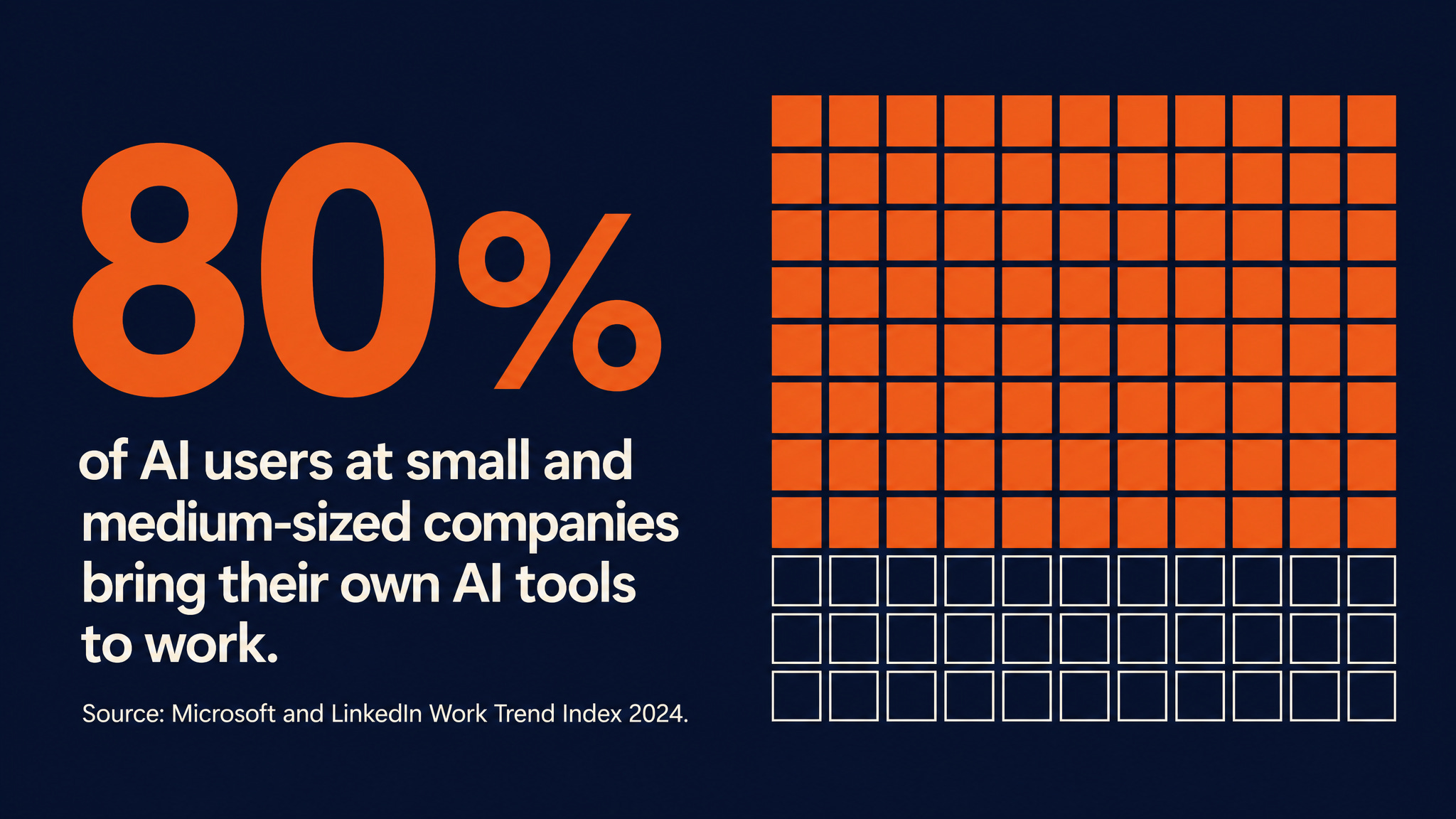
Microsoft and LinkedIn found that 78% of AI users bring their own AI tools to work. In small and medium-sized companies, that number rises to 80%. That is the adoption story most leaders are missing.
Your company may not have an AI strategy. Your employees already have one.
It is just fragmented, unofficial, uneven, and probably not connected to the work that actually matters.
The beginner problem is not that people do not know enough. Nobody knows enough yet. The tools are moving too quickly, the use cases are too varied, and most businesses are still figuring out where AI belongs inside daily operations.
The expensive part is when people pretend they know.
When employees are embarrassed to ask basic questions, they do not ask better ones. When managers feel pressure to sound current, they buy tools before mapping the work. When leaders treat AI as a competence performance, teams hide confusion instead of surfacing opportunities.
That is how you get a company full of AI activity with no operational improvement.
The hidden adoption is already happening
The same Microsoft and LinkedIn report found that 52% of people who use AI at work are reluctant to admit they use it for their most important tasks, and 53% worry that using AI on important tasks makes them look replaceable.
That is not a skills issue. That is a trust issue.
If your people are hiding AI usage, you cannot improve it. You cannot set standards. You cannot protect customer data. You cannot identify what is working. You cannot turn isolated tricks into repeatable systems.
Most SMBs do not need an AI guru. They need an environment where someone can say, “I tried this, I do not fully understand it yet, but it saved me 40 minutes.”
That sentence is worth more than a polished AI strategy deck nobody uses.
Certainty is expensive when the tools are changing this fast.
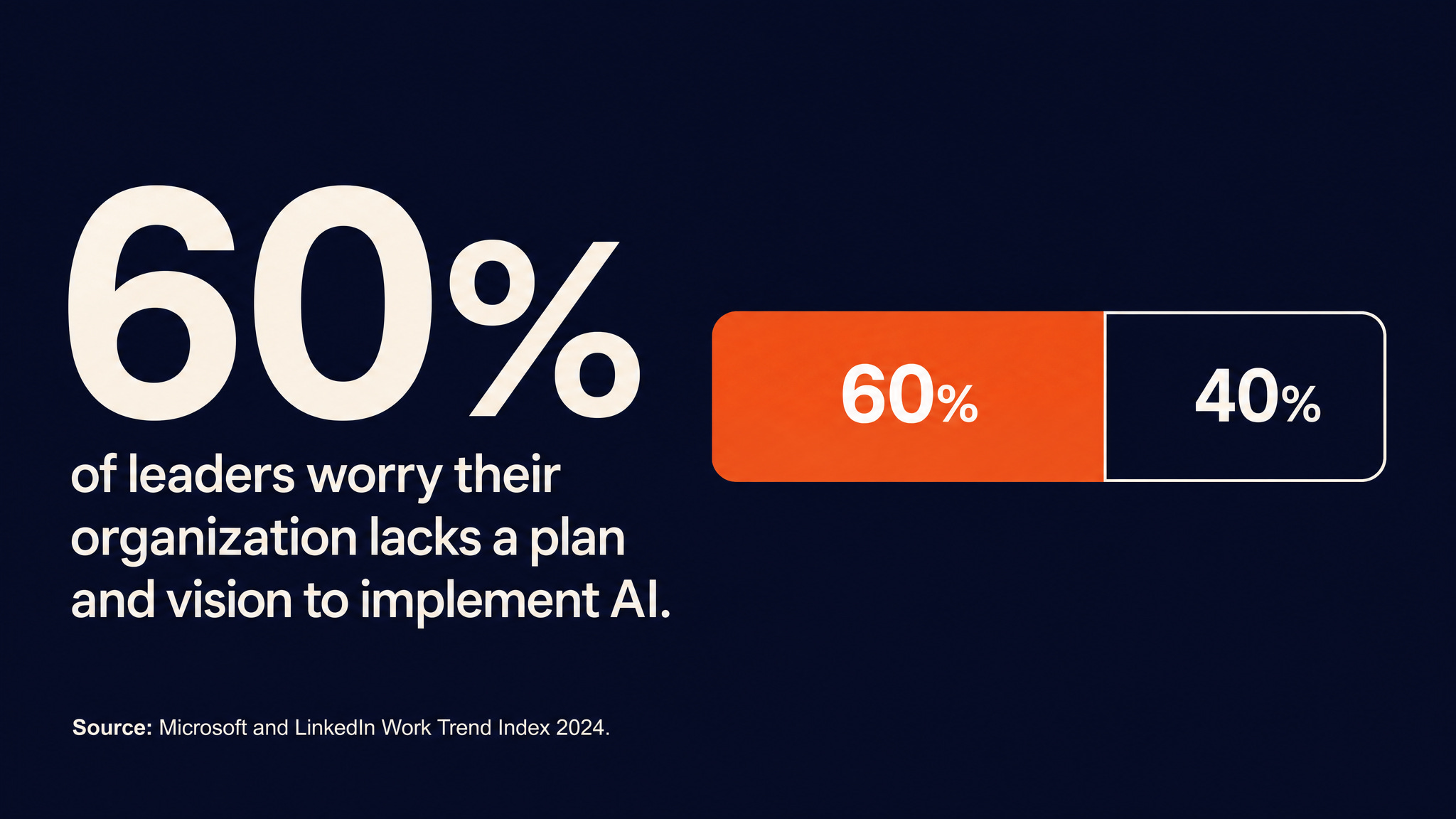
Sixty percent of leaders worry their organization lacks a plan and vision to implement AI. At the same time, 79% of leaders agree their company needs AI to stay competitive.
That gap is where bad decisions live.
Leaders know AI matters, but many do not know where to start. So they stall, copy competitors, buy whatever tool has the loudest demo, or tell employees to “use AI” without defining what useful means.
That is not leadership. That is anxiety management.
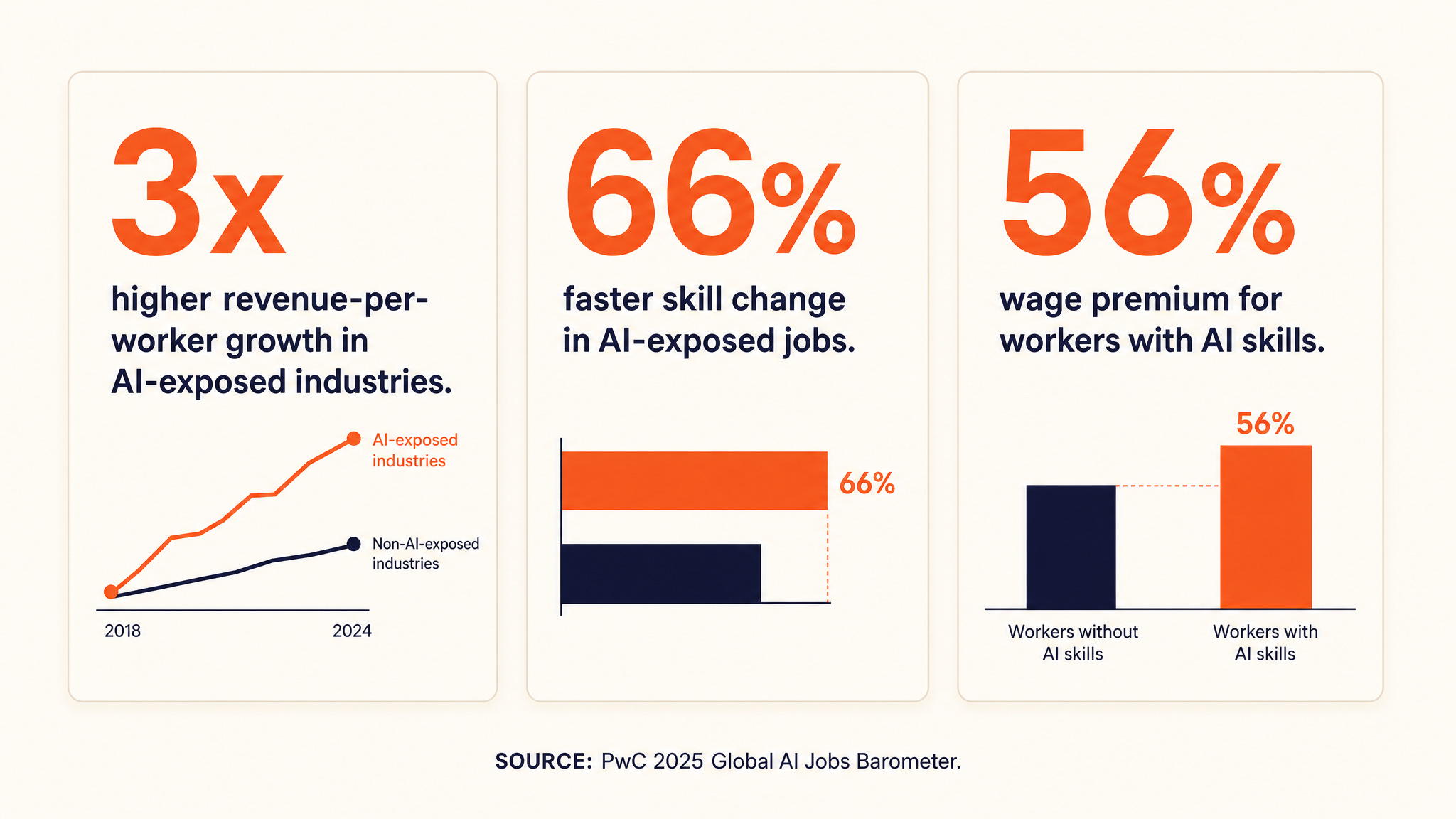
PwC’s 2025 AI Jobs Barometer shows why this matters. Industries more exposed to AI are seeing three times higher growth in revenue per worker. Skills in AI-exposed jobs are changing 66% faster than in less exposed jobs. Workers with AI skills now command a 56% wage premium.
The market is not waiting for your team to feel comfortable.
AI confidence is not the same as AI competence
There is a dangerous middle stage in AI adoption: people know enough vocabulary to sound fluent, but not enough operating discipline to create value.
They can say “agent.” They can say “prompt engineering.” They can show a chatbot answer. They can build a quick demo. But they cannot answer the boring question that actually matters:
What work did this remove, improve, accelerate, or clarify?
If the answer is vague, the AI initiative is probably noise.
Small businesses cannot afford noise. They do not have enterprise budgets to waste on experimentation that never becomes execution. They need a tighter standard: if AI does not reduce wasted work, improve decisions, speed up handoffs, or protect capacity, it is not strategy. It is a toy.
Beginner teams learn faster than performative teams.
Harvard Business Review’s summary of psychological safety describes the core idea simply: people need to feel safe speaking up, especially when something is uncertain, risky, or not working. AI adoption is exactly that kind of environment.
Beginner teams ask better questions because they are not wasting energy protecting an image.
They ask:
-
What are we doing manually that repeats every week?
-
Where do customers wait because our internal process is slow?
-
Where does information get copied, cleaned, summarized, or reformatted?
-
Which decisions are delayed because the data is scattered?
-
Which tasks feel productive but do not deserve human attention?
Those questions are not glamorous. Good. Glamour is usually where AI projects go to die.
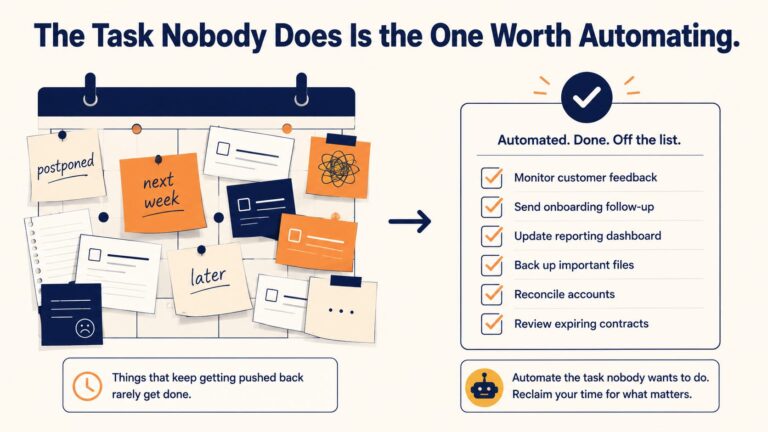
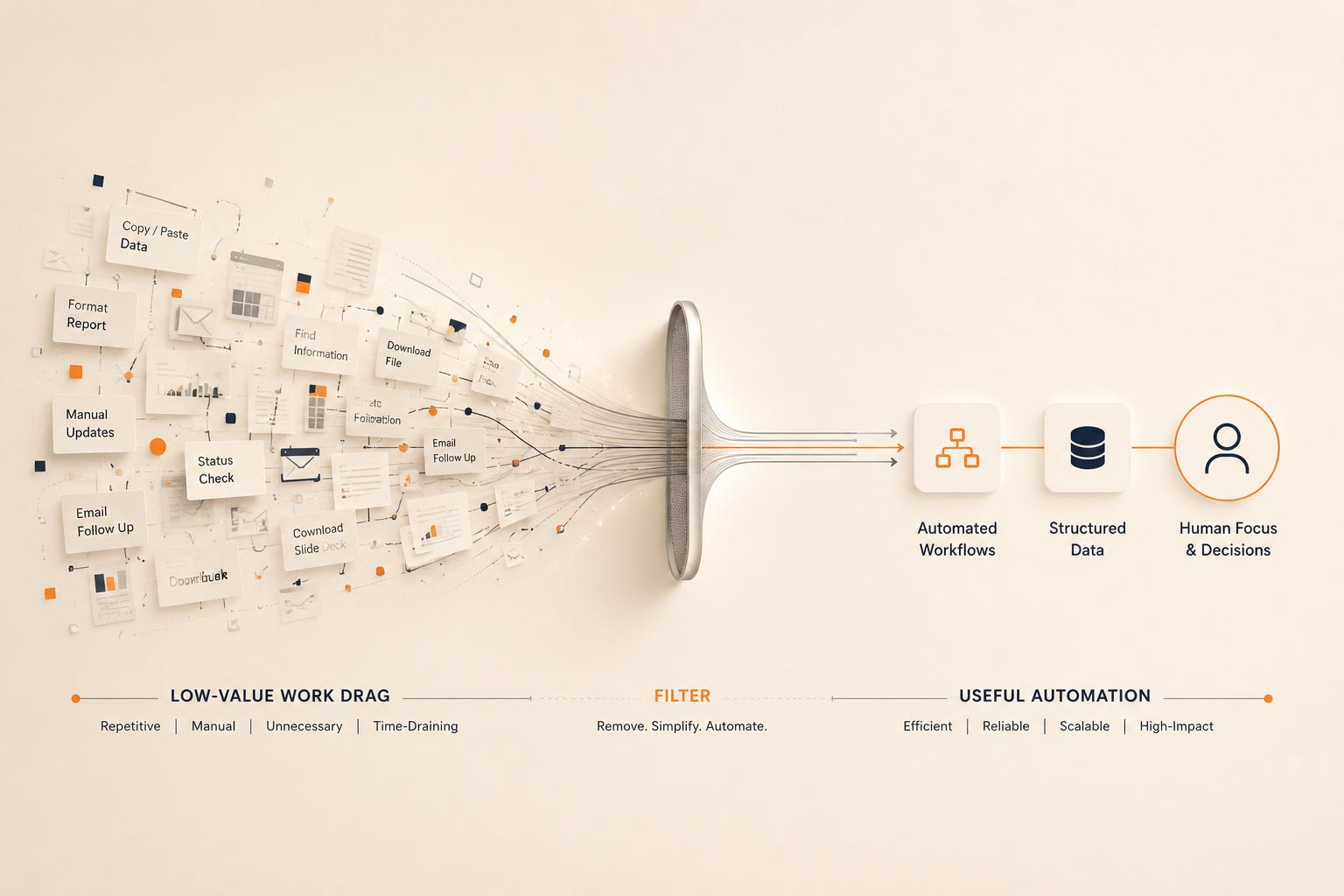
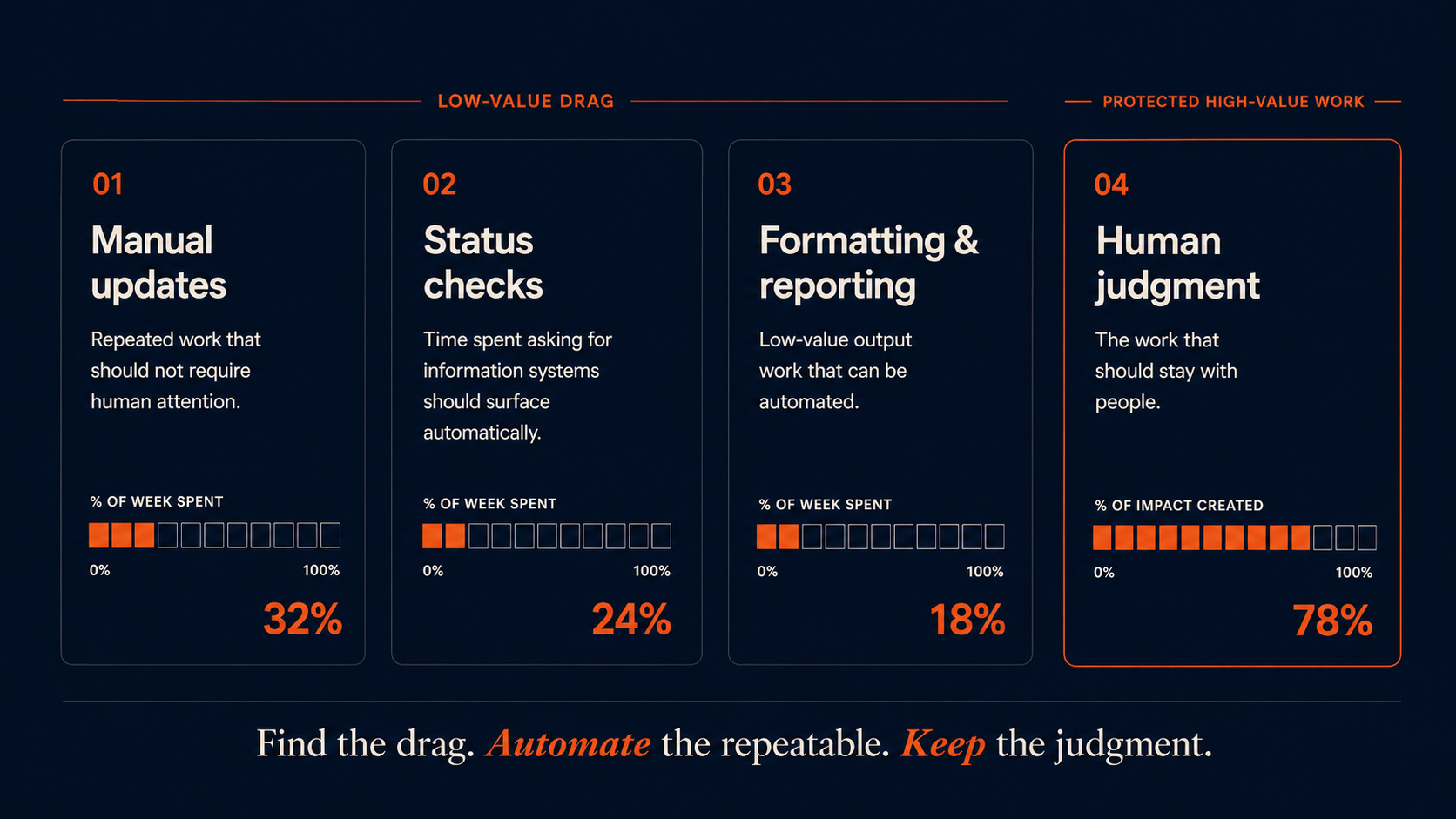
The useful opportunities are often buried in admin drag, reporting friction, customer follow-up, document handling, intake forms, scheduling, quoting, routing, reconciliation, and internal updates. That is where AI workflow automation can actually protect time.
Performative AI adoption skips the uncomfortable part
Performative teams want the answer to look impressive immediately. Beginner teams are willing to look confused long enough to understand the problem.
That difference matters.
Microsoft’s 2023 Work Trend Index found that 68% of people do not have enough uninterrupted focus time, and the average employee spends 57% of Microsoft 365 time communicating instead of creating. In 2024, the communication share rose to 60%.
That is the real target. Not “AI transformation.” Not “becoming an AI company.” Not adding another subscription to the monthly stack.
The target is wasted work.
If AI does not help your team reclaim time from low-value coordination, repetitive admin, messy information flow, or decision lag, then what exactly are you adopting?
The goal is not to become an AI expert. The goal is to find wasted work.
This is where small business AI strategy usually goes sideways. Leaders start with the tool instead of the workflow.
They ask, “Should we use ChatGPT, Copilot, Claude, Gemini, Zapier, Make, custom agents, or something else?”
Wrong first question.
The better question is: where is human time being wasted because the process is badly designed?
AI is not magic dust. It is leverage. Leverage only helps when it is applied to the right point.
A custom AI automation that cleans intake data, drafts first-pass responses, routes requests, summarizes customer history, or prepares a weekly decision report can be worth far more than a team casually using chatbots to write slightly better emails.
The tool is secondary. The workflow is the asset.
Look for drag, not novelty
The best first AI projects usually have a few traits:
-
The task happens often enough to matter.
-
The current process wastes human attention.
-
The inputs and outputs are clear enough to define.
-
The risk is manageable with human review.
-
The result can be measured in time saved, faster response, fewer errors, or better decisions.
That is not sexy. It is useful.
And useful beats impressive every time.
Start with one workflow, not a company-wide AI fantasy.
Microsoft’s 2025 Work Trend Index reports that 46% of leaders say their companies are using agents to fully automate workflows or processes. That sounds advanced, but the principle behind it is simple: automate work where the pattern is clear and the human value is low.
Small businesses do not need to jump straight into agent orchestration, autonomous workflows, or some bloated transformation roadmap.
Start smaller. Start sharper.
Pick one workflow that is painful enough to matter and contained enough to fix.
Examples:
-
Lead intake that currently depends on someone manually sorting emails.
-
Customer support questions that repeat every week.
-
Reports that require copying data from three systems.
-
Internal updates that create meetings instead of decisions.
-
Proposal drafts that start from scratch every time.
-
Scheduling, reminders, and follow-up that fall through the cracks.
Then map the workflow before choosing the solution.
The first useful AI project should create proof
Do not start with a company-wide AI policy workshop that creates 19 pages of abstract principles and zero operational change.
Start with proof.
Proof that one workflow can run faster. Proof that one repetitive task can be reduced. Proof that one decision process can get cleaner. Proof that one team can stop wasting time on work that should not need a human every single time.
That proof builds confidence the honest way. Not by pretending everyone understands AI, but by showing them exactly where it helped.
Stop acting finished.
The companies that win with AI will not be the ones that act the smartest in the room. They will be the ones that learn fastest without turning the learning process into a performance.
Admit the gap. Ask the basic question. Map the workflow. Find the drag. Build one useful automation. Measure the result. Then move to the next one.
That is smart hustle.
Pretending is stupid hustle. It looks busy, sounds current, and wastes time.
AI adoption for small business should not be about chasing whatever tool is trending this week. It should be about protecting capacity, reducing operational drag, and helping the team do work that actually matters.
If your team is curious about AI but stuck in the awkward beginner stage, you do not need more noise. You need a practical map from messy work to useful automation. I help SMBs identify the workflows worth fixing, design custom AI automation around the real bottleneck, and avoid wasting time on tools that only look good in a demo.
If that is where your business is right now, reach out through [email protected] and let’s talk.