If you run a local business and you assume that ranking well on Google means AI tools will recommend you, the new SOCi 2026 Local Visibility Index has a wake-up call for you.
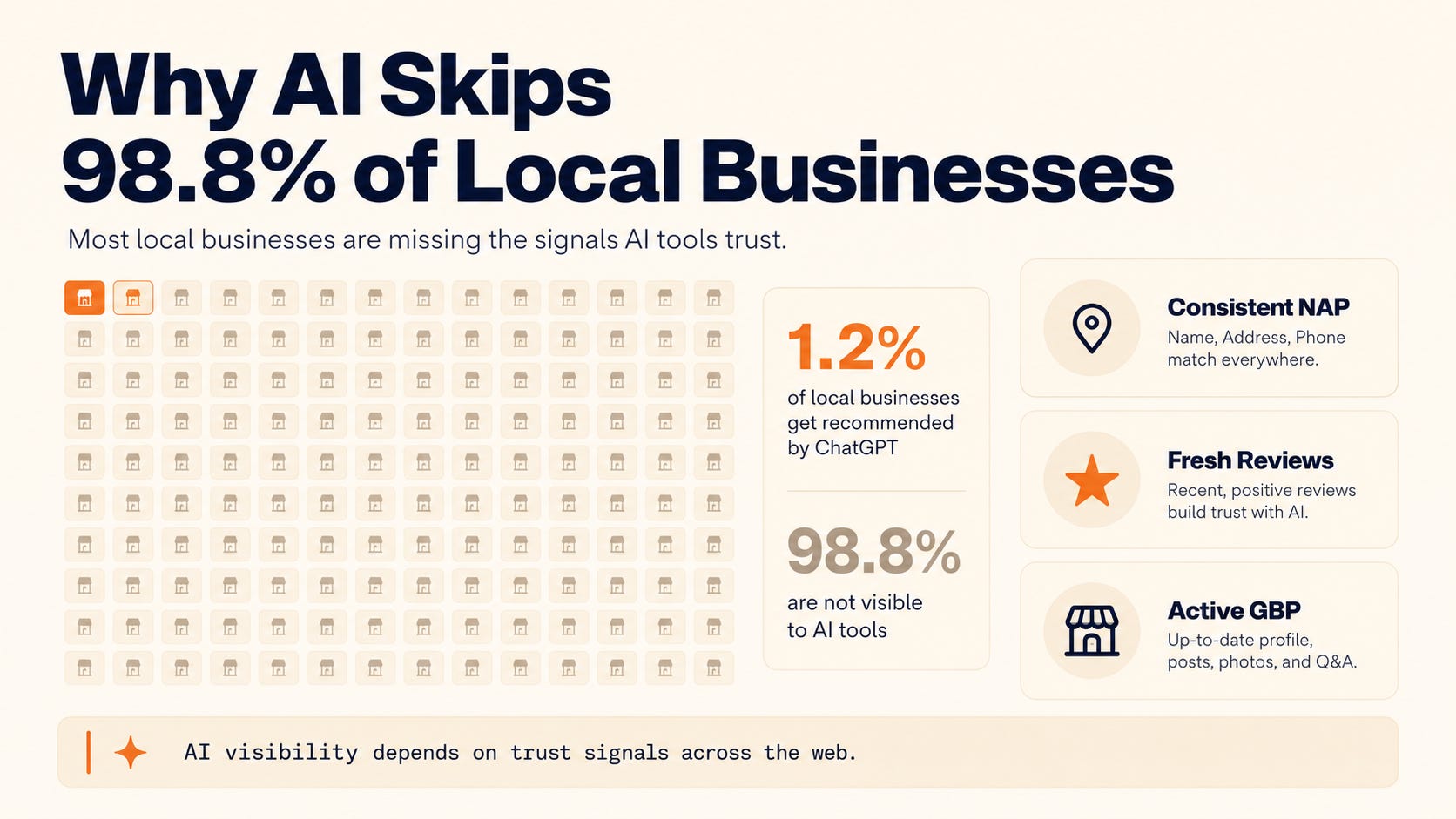
ChatGPT recommends only 1.2% of local business locations.
Compare that to Google’s traditional 3-pack, which surfaces 35.9% of businesses for a given local search. That is a 30x gap between what AI assistants recommend and what Google Search shows.
The businesses that show up in both places are rare. SOCi found that only 45% of top Google-ranked businesses even appear in AI recommendations at all. Half of the businesses dominating Google’s local results are invisible to ChatGPT, Perplexity, and other AI tools.
This is not a slow shift. It is already happening. And most local businesses have done nothing about it
.
The Numbers That Should Worry You
SOCi’s 2026 Local Visibility Index measured how thousands of business locations perform across AI-powered search tools. The results are rough for anyone relying on Google rankings alone.
ChatGPT recommends 1.2% of local business locations. For every 100 businesses competing in your category and area, one of them gets the nod from ChatGPT. One.
Google’s 3-pack surfaces 35.9% of businesses. Traditional local search still casts a much wider net. But as AI Overviews expand and the AI Local Pack replaces the traditional 3-pack on more queries, that net is shrinking.
Only 45% overlap between Google top performers and AI-recommended businesses. If you are in the top 3 on Google, there is still a 55% chance an AI tool will skip right past you.
Business information accuracy is just 68% on ChatGPT and Perplexity. These tools pull from multiple sources, and when your NAP, meaning name, address, and phone, is inconsistent across the web, the AI gets confused and omits you. Meanwhile, Google’s Gemini scores 100% accuracy on business info because it pulls directly from Google Maps data.
The takeaway: Google rankings are not a proxy for AI visibility. They are different games with different rulebooks.
The 29 Signals AI Tools Use to Decide Who Gets Recommended
SOCi identified 29 distinct signals that AI tools weigh when deciding which businesses to recommend. They break down into a few categories you can actually control.
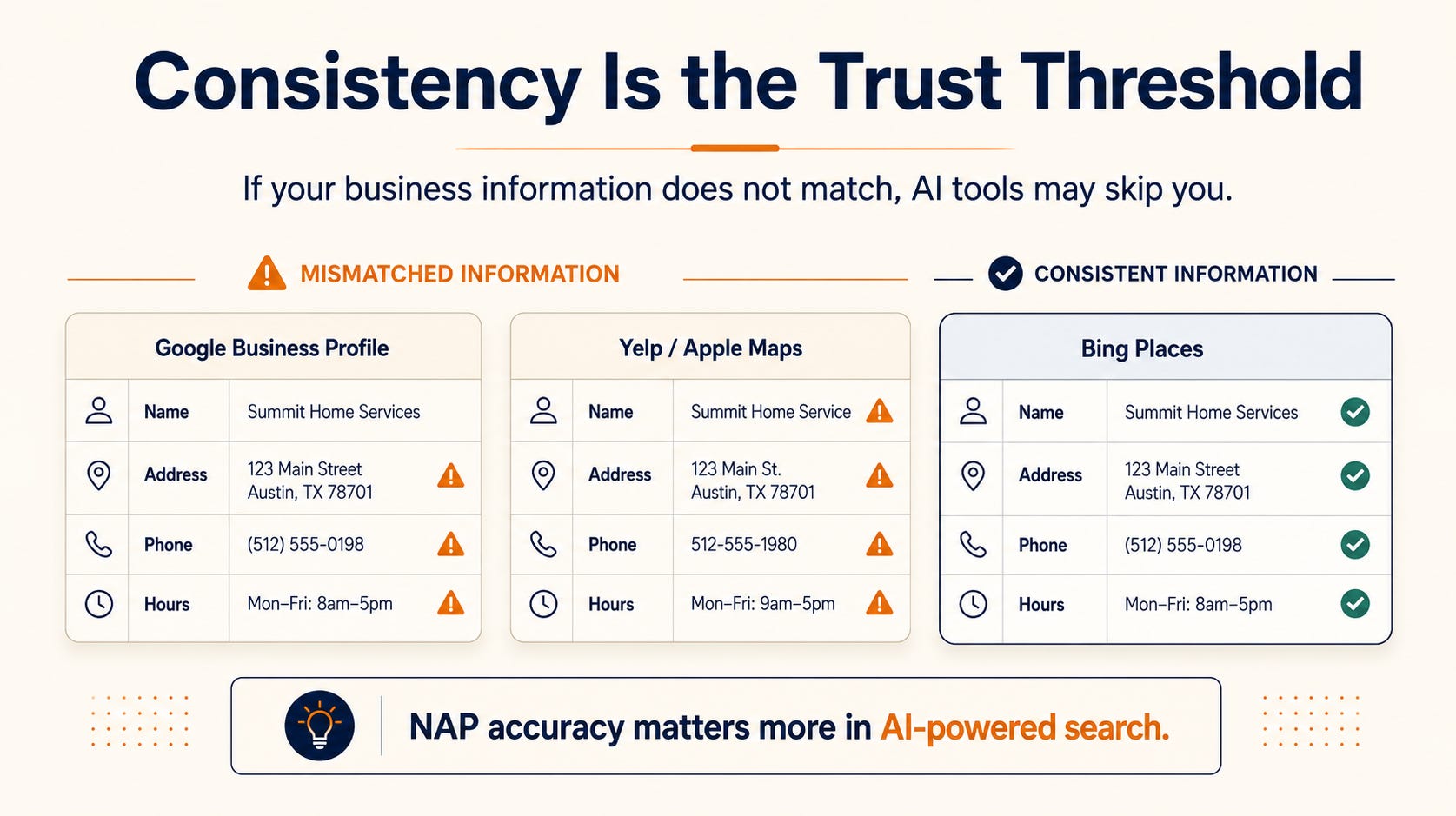
Citation consistency across platforms. When your business name, address, and phone number match perfectly across Google, Bing, Apple Maps, Yelp, Facebook, and industry directories, AI tools trust the data. When there are mismatches, even small ones, the AI treats the information as unreliable and moves on.
Review volume, recency, and sentiment. AI tools do not just count stars. They analyze what people say, how recently they said it, and whether the sentiment is consistent across platforms. A business with 100 Google reviews but zero Yelp reviews looks incomplete. A business with recent reviews on 4+ platforms looks trustworthy.
Service-area and category specificity. Vague categories like “Contractor” perform worse than specific ones like “Licensed Residential Electrician” with defined service areas. AI tools need to match you to specific queries, and vague profiles give them less to match against.
Content depth and freshness. Businesses that publish regularly, including GBP posts, website updates, and blog content, signal activity to AI tools. A profile that has not been updated in six months looks abandoned, and AI tools de-prioritize abandoned profiles.
Visual content. Photos and videos of real work matter. AI tools can analyze image content and factor it into relevance. A plumber with 30 photos of completed jobs looks more real and more relevant than one with a logo and a stock photo of a wrench.
Third-party validation. Mentions on local news sites, chamber of commerce listings, industry association directories, and community forums all add weight. AI tools treat these as independent signals of legitimacy.
Why NAP Consistency Matters More Than Ever
The 68% accuracy rate on ChatGPT and Perplexity is not a bug. It is a direct result of businesses treating their online information as a one-and-done task.
Here is what happens when your NAP is inconsistent:
A potential customer asks ChatGPT “best electrician near me open on weekends.” ChatGPT scans the web for data. It finds your Google Business Profile with one phone number, an old Yelp listing with a different number from three years ago, a BBB profile with an abbreviated business name, and an Apple Maps listing that does not mention weekend hours.
The AI sees conflicting information and treats your business as unreliable. It recommends the electrician down the street whose information is identical across 12 platforms.
Consistency is not a ranking factor. It is a trust threshold. If you fail it, AI tools do not rank you lower. They exclude you entirely.
Gemini’s 100% accuracy rate tells you why this matters: it pulls from Google Maps, which is a single, centralized dataset. ChatGPT and Perplexity pull from across the web. If your information is scattered and inconsistent, those tools cannot reconcile it. You disappear.
Practical Fixes That Move the Needle
This is not a problem that requires a six-figure marketing budget. Most of the fixes are free or affordable. They take time and consistency, not money.
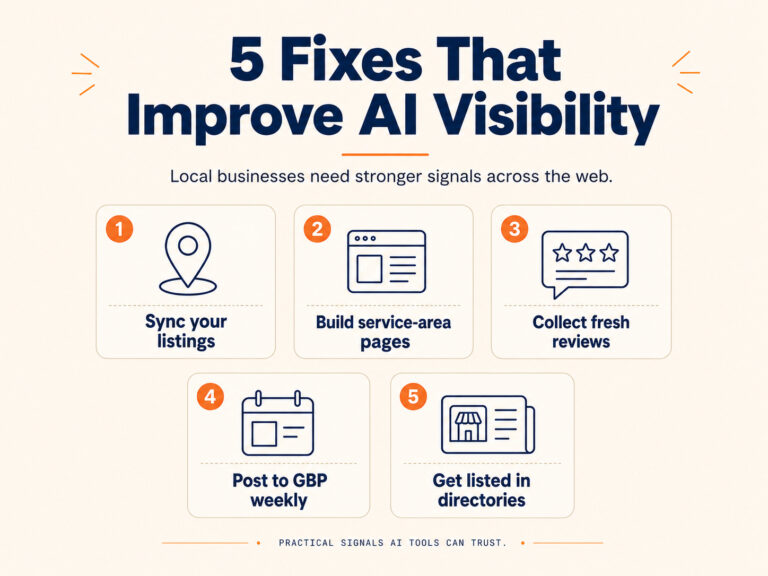
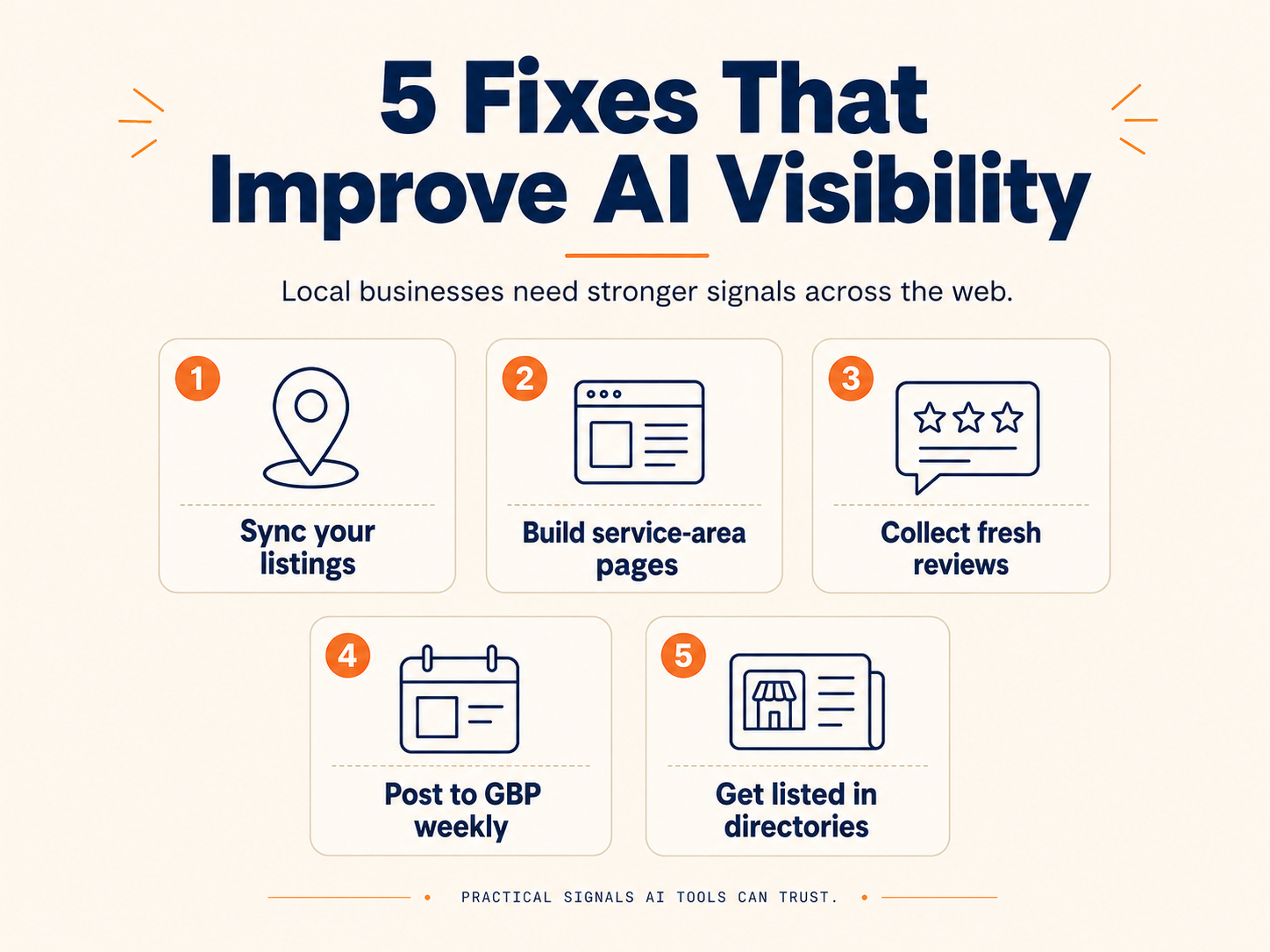
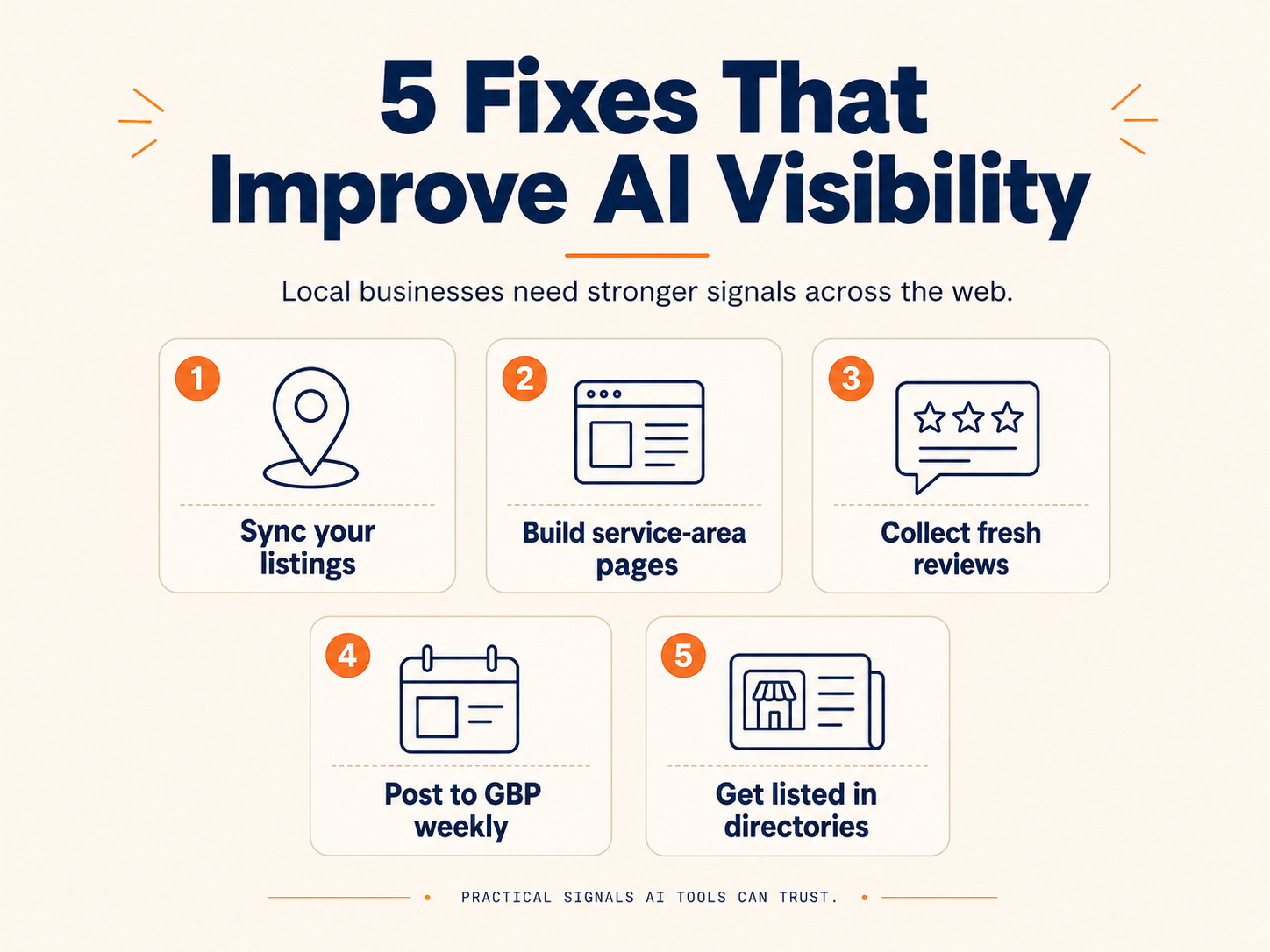
1. Claim and Sync Your Listings on Bing, Apple Maps, and Yelp
Google is not enough. ChatGPT pulls from Bing’s index. Perplexity pulls from multiple sources. If your business does not exist on Bing Places, Apple Maps, and Yelp, you are invisible to the AI tools that rely on them.
Claim your listings. Make sure your name, address, and phone number match your Google Business Profile exactly. Watch for abbreviations: “St.” vs “Street” and “Ste” vs “Suite” matter. AI tools treat these as different strings.
2. Build Service-Area Pages on Your Website
A single “Services” page that lists everything you do is not enough. Each service needs its own page with specific information about what you do, where you do it, and who it is for.
An HVAC company should have separate pages for furnace repair, AC installation, heat pump maintenance, and duct cleaning. Each page should include the cities and neighbourhoods served, common questions customers ask, and real information about what the service involves.
AI tools cite specific pages, not generic ones. When someone asks “who does heat pump repair in Langley,” the AI looks for a page about heat pump repair that mentions Langley. A generic “Our Services” page does not match.
3. Collect Fresh Reviews Across Multiple Platforms
If your last review was four months ago, AI tools consider your profile stale. If all your reviews are on Google and nothing on Yelp or Facebook, your review footprint looks incomplete.
Ask every customer for a review. Do not gate it by only asking happy customers. Do not offer incentives. Just ask, make it easy, and rotate which platform you send them to so your review profile is distributed.
The target: 50+ recent reviews spread across 3+ platforms. That is the SOCi threshold where AI visibility starts to compound.
4. Post Updates to Your GBP Weekly
Google posts, offers, updates, and photos. Do something every week. It signals activity to both Google and AI tools that scrape GBP data.
A plumber posting a photo of a completed water heater install with a short description of the job every week looks alive and active. A plumber whose last post was in 2023 looks like they might not answer the phone. AI tools make the same assumptions humans do.
5. Get Listed in Industry and Local Directories
Your local chamber of commerce. Your industry association. The Better Business Bureau. Local news site business directories. HomeStars, Houzz, or TrustedPros if you are in trades.
These are independent signals that AI tools treat as validation. Each one adds weight. None of them are expensive. Most are free.
This Hits SMBs Harder Than Enterprises
Enterprise brands have teams tracking this. They have citation management software. They have review monitoring. They have dedicated SEO staff who read the SOCi report the week it came out.
Local SMBs do not have any of that. The plumber running a three-person shop in Burnaby is not reading the SOCi 2026 Local Visibility Index. They are busy running a plumbing business.
That means the gap between businesses that show up in AI recommendations and businesses that do not is going to widen fast. The early movers who fix their citations, build out their profiles, and collect reviews across platforms are going to capture AI-driven leads while their competitors do not even know AI-driven leads exist.
For SMBs, this is not a “someday” problem. The consumers are already using AI tools to find local businesses. BrightLocal’s 2026 survey found 45% of consumers use ChatGPT for local business recommendations, up from 6% in 2025. The train left the station. The question is whether your business is on it.
How JC Labs Helps
This is the work we do every day for trade businesses and local service companies.
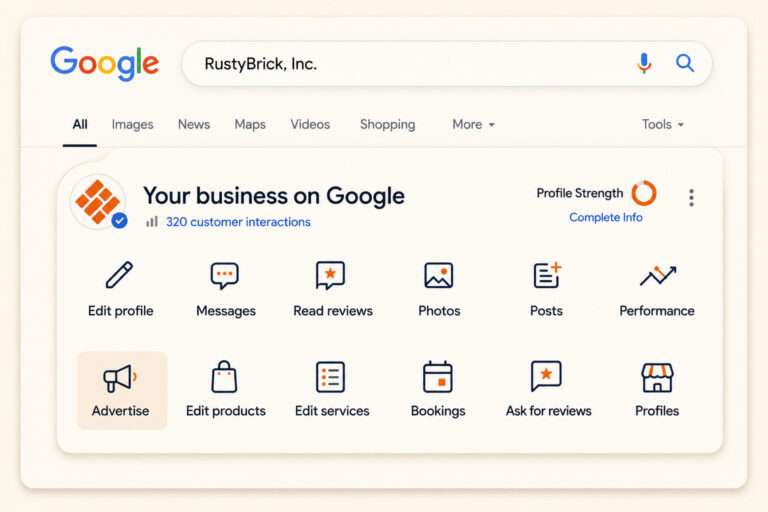
GBP management. We keep your Google Business Profile complete, active, and accurate. Posts, photos, Q&A, services, attributes. Every section filled. Every signal Google’s AI needs to recommend you.
Local SEO. We make sure your NAP is consistent across the platforms that matter. Google, Bing, Apple Maps, Yelp, Facebook, and industry directories. When AI tools scan the web for business information, yours matches everywhere they look.
GEO, or Generative Engine Optimization. We build the content, structure, and signals that get your business cited by ChatGPT, Perplexity, Google AI Overviews, and every other AI tool consumers are using to find local services.
If your business is invisible to AI recommendations, that is fixable. But the fix is not one thing. It is the consistent application of a lot of small things that add up to a signal AI tools trust.
Let’s talk about getting your business into the 1.2%.
If your local business is not showing up where customers are searching, that can be fixed.
JC Labs helps trades and local service businesses improve visibility across Google Business Profile, local SEO, reviews, and AI-powered search.
Visit
https://www.thejclabs.com/
to learn how we can help your business get found, trusted, and chosen.