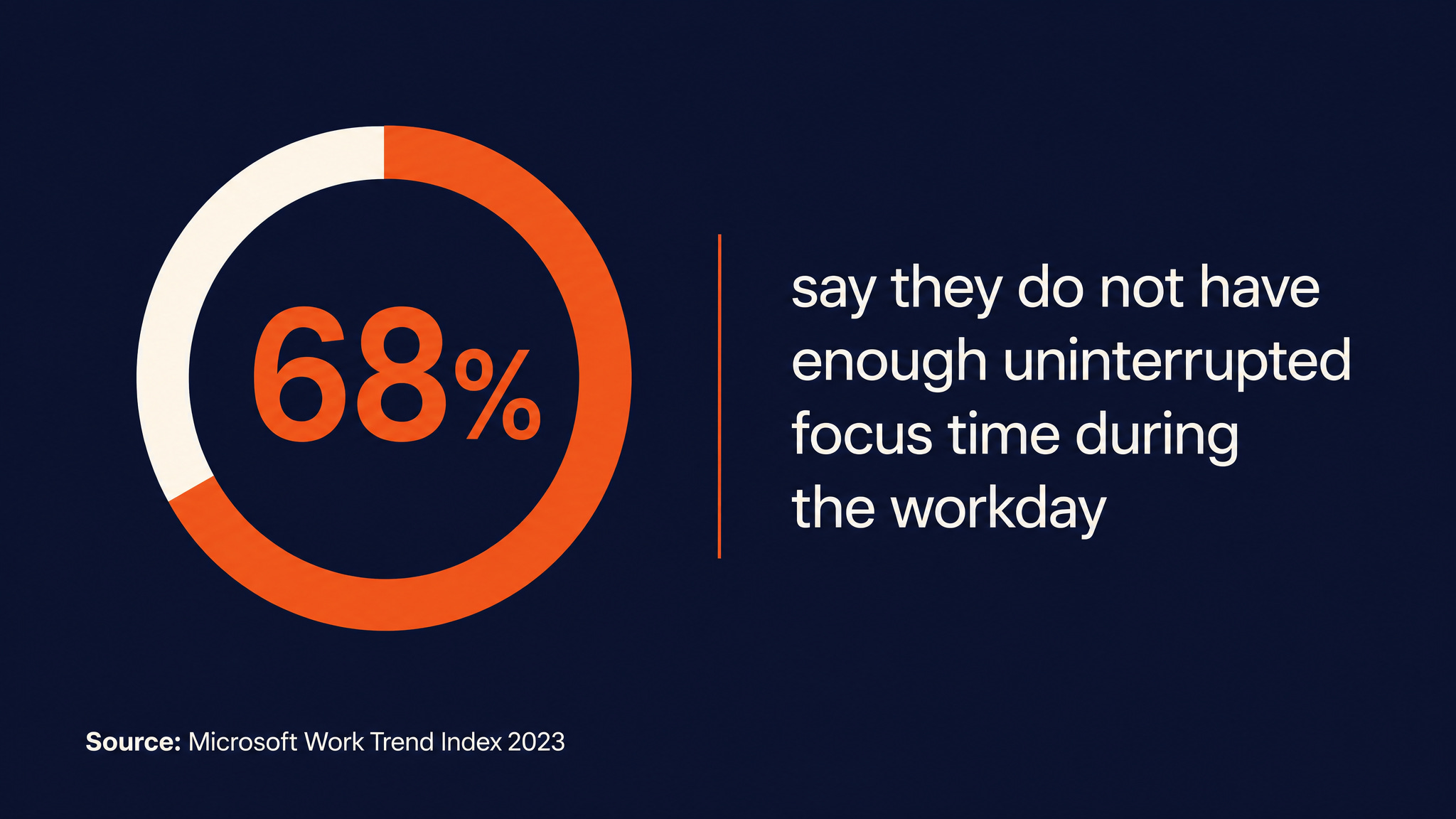
Sixty-eight percent of people say they do not have enough uninterrupted focus time during the workday, according to Microsoft’s 2023 Work Trend Index. That should bother every leader, consultant, marketer, founder, and employee who still thinks more words equals more value.
The workplace is not starving for more communication. It is drowning in it.
Emails. Meetings. Chat threads. Reports. Decks. Memos. Updates. AI-generated summaries of updates about meetings that should have been one sentence in the first place.
Here is the part most people do not want to admit: a lot of long communication is not deep thinking. It is unclear thinking with better formatting.
Talking less does not make you less intelligent. Done properly, it makes you sound smarter because it forces the one thing most communication avoids: mental clarity. You have to dissect the idea, find the meat, remove the fat, and say what actually helps the other person understand, decide, or act.
Nobody wants to sit through a lecture when the point can be said in less than 10 words.

The workplace is already drowning in words
Microsoft found that the average employee spends 57% of their time communicating in meetings, email, and chat, and only 43% creating in documents, spreadsheets, and presentations. In the 2024 Work Trend Index, that communication share rose to 60% across Microsoft 365 usage.
That is not a communication problem. That is an execution problem wearing a communication costume.
When most of the workday is spent moving information around, every extra paragraph becomes a tax. Every unclear meeting becomes a withdrawal from the company’s focus account. Every bloated document asks someone else to do the thinking the writer should have done before hitting send.
Long emails are not deeper thinking
Microsoft’s 2024 report says 85% of emails are read in under 15 seconds, and the typical person has to read about four emails for every one they send. That should change how people write.
If your reader is giving you 15 seconds, your job is not to prove how much you know. Your job is to make the point impossible to miss.
A long email can be useful when the situation deserves depth. Most do not. Most long emails are long because the writer did not decide what mattered. They put everything in and transferred the burden to the reader.
That is not thorough. It is lazy.
Concise communication is not fewer words for the sake of fewer words. It is a discipline. It asks: what is the point, what does the reader need, and what can be removed without damaging the decision?
Fancy decks and polished pages can still waste time
This is not just about email. The same disease shows up in presentations, proposals, websites, sales decks, reports, and internal documents.
Design can make bad thinking look more expensive. AI can make weak ideas sound more polished. Neither fixes the real issue.
If the message is unclear, polish just makes the waste prettier.
Nielsen Norman Group found that users often read only about 20% of the text on an average web page. Their earlier usability research found that 79% of users scanned new pages, while only 16% read word by word. Concise text improved usability by 58%, and combining concise, scannable, objective writing improved usability by 124%.
That data says something simple: people reward clarity. They punish fluff by ignoring it.
AI made the noise problem cheaper
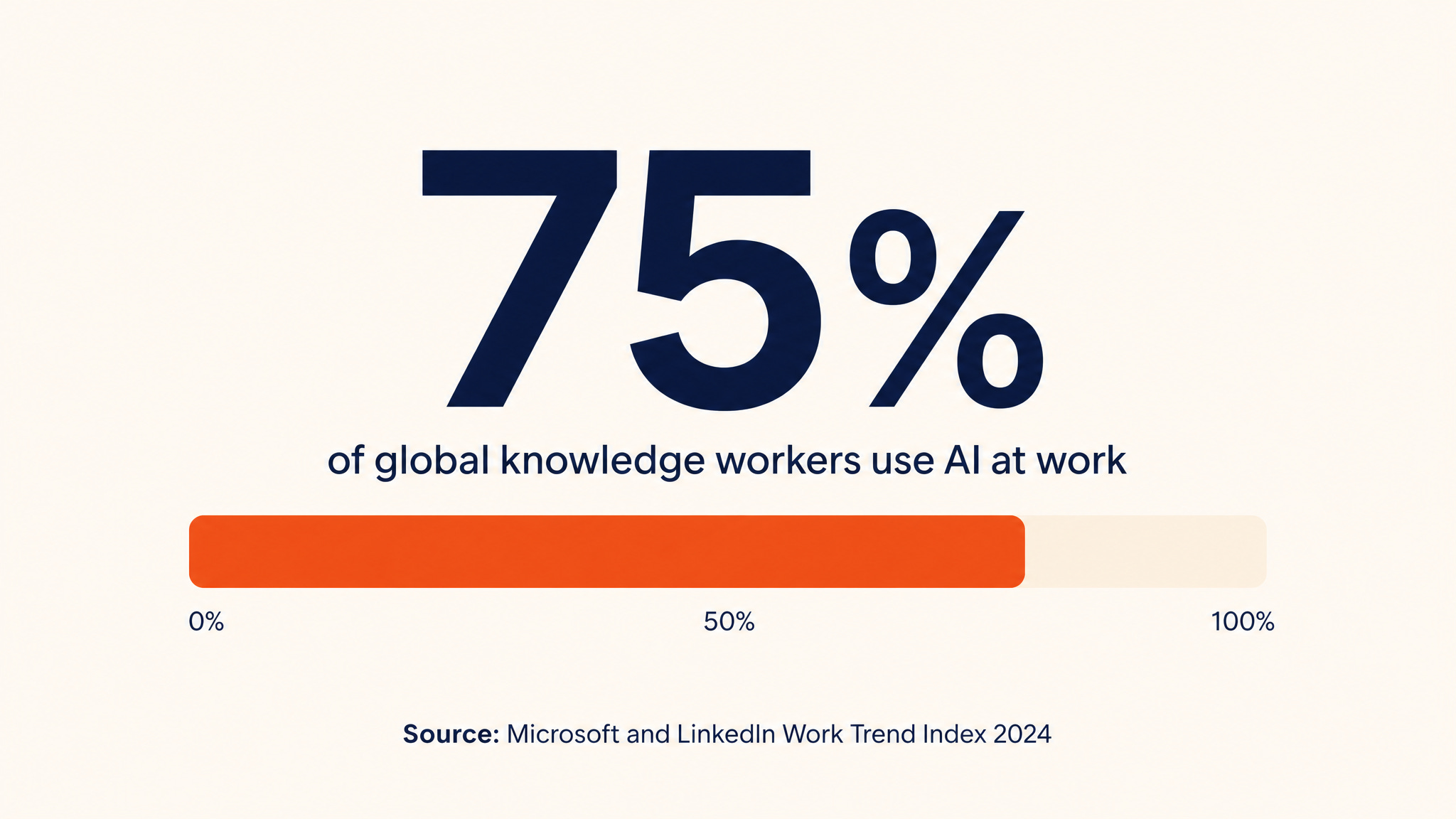
Seventy-five percent of global knowledge workers now use AI at work, according to the 2024 Microsoft and LinkedIn Work Trend Index. Usage nearly doubled in six months. That is not a future trend. It is already inside the workday.
The upside is obvious. AI can help people move faster, summarize information, draft faster, and get unstuck. Microsoft found that AI users say it helps them save time (90%), focus on their most important work (85%), be more creative (84%), and enjoy work more (83%).
The danger is just as obvious. AI makes it easier to produce more words before you have earned the right to say anything.
Before, writing too much took effort. Now it takes one prompt.
That is the shift leaders need to understand. In the past, turning a weak thought into a five-page memo took time. Now it takes seconds.
One sentence can become a strategy brief. One vague idea can become a polished website section. One messy opinion can become a full article, pitch deck, email campaign, or executive summary.
That does not mean the thinking improved. It means the packaging got cheaper.
AI is useful when it sharpens the point. It is dangerous when it inflates the point.
Output volume is not contribution
Microsoft found that 68% of people struggle with the pace and volume of work, and 46% feel burned out. That is what happens when organizations confuse activity with impact.
More content does not automatically create more value. More documents do not automatically create more alignment. More meetings do not automatically create more leadership.
The question is not, “Can we generate this?”
The better question is, “Does this help someone think, decide, or act faster?”
If the answer is no, you are not communicating. You are creating review burden.
The real skill is compression
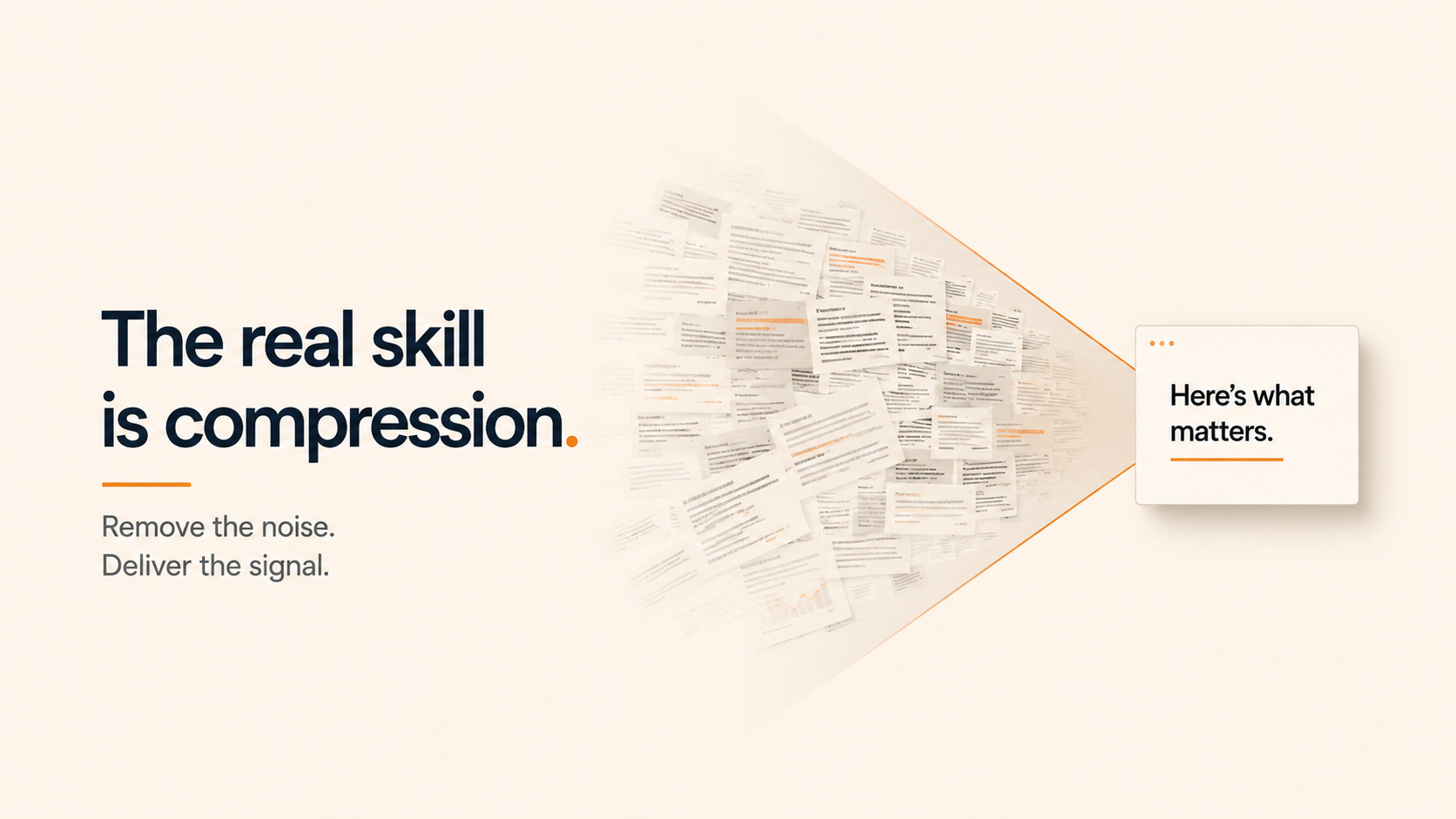
The smartest communicators are not the ones who say the most. They are the ones who can compress complexity without destroying meaning.
That takes judgment. It takes restraint. It takes actual understanding.
Anyone can keep adding context. The hard part is deciding what does not belong.
Concision is not laziness. It is judgment.
Nielsen Norman Group’s research found that concise text produced a 58% usability improvement compared with promotional writing. That matters because clarity is not just a writing preference. It changes whether people can use the information.
This is where a lot of professionals get it backwards. They think the longer answer sounds more intelligent. Sometimes it does. But often it just exposes that they have not found the centre of the idea.
If you understand something well, you can usually make it simpler. Not simplistic. Simpler.
There is a difference.
Simplistic removes the truth. Simple removes the clutter.
Useful communication answers one question
Every message should answer one question before it leaves your hands: what does this help the other person do?
If it helps them understand, it has value.
If it helps them decide, it has value.
If it helps them act, it has value.
If it only helps you sound smart, cut it.
This is the difference between performance and contribution. Performance communication is speaker-centred. It asks, “How do I look?” Contribution communication is reader-centred. It asks, “What does this person need from me right now?”
That shift changes everything.
Use AI as an editor, not a volume machine
Microsoft’s 2024 research found that 79% of leaders believe their company needs to adopt AI to stay competitive, but 60% worry their organization lacks a plan and vision to implement it.
That gap is exactly where bad AI habits form.
When companies do not define what good looks like, employees use AI to produce more. More emails. More proposals. More reports. More posts. More summaries. More “professional” communication that still wastes time.
That is not smart hustle. That is stupid hustle with better tools.
Ask AI to remove, challenge, and clarify
The best AI communication prompts are not expansion prompts. They are reduction prompts.
Use prompts like these:
-
Rewrite this in half the length without losing the point.
-
Remove anything that sounds impressive but does not add value.
-
What is the one thing the reader needs to understand?
-
Turn this into a decision-ready summary.
-
Cut this to the shortest version that still sounds human.
-
Tell me where I am hiding weak thinking behind long wording.
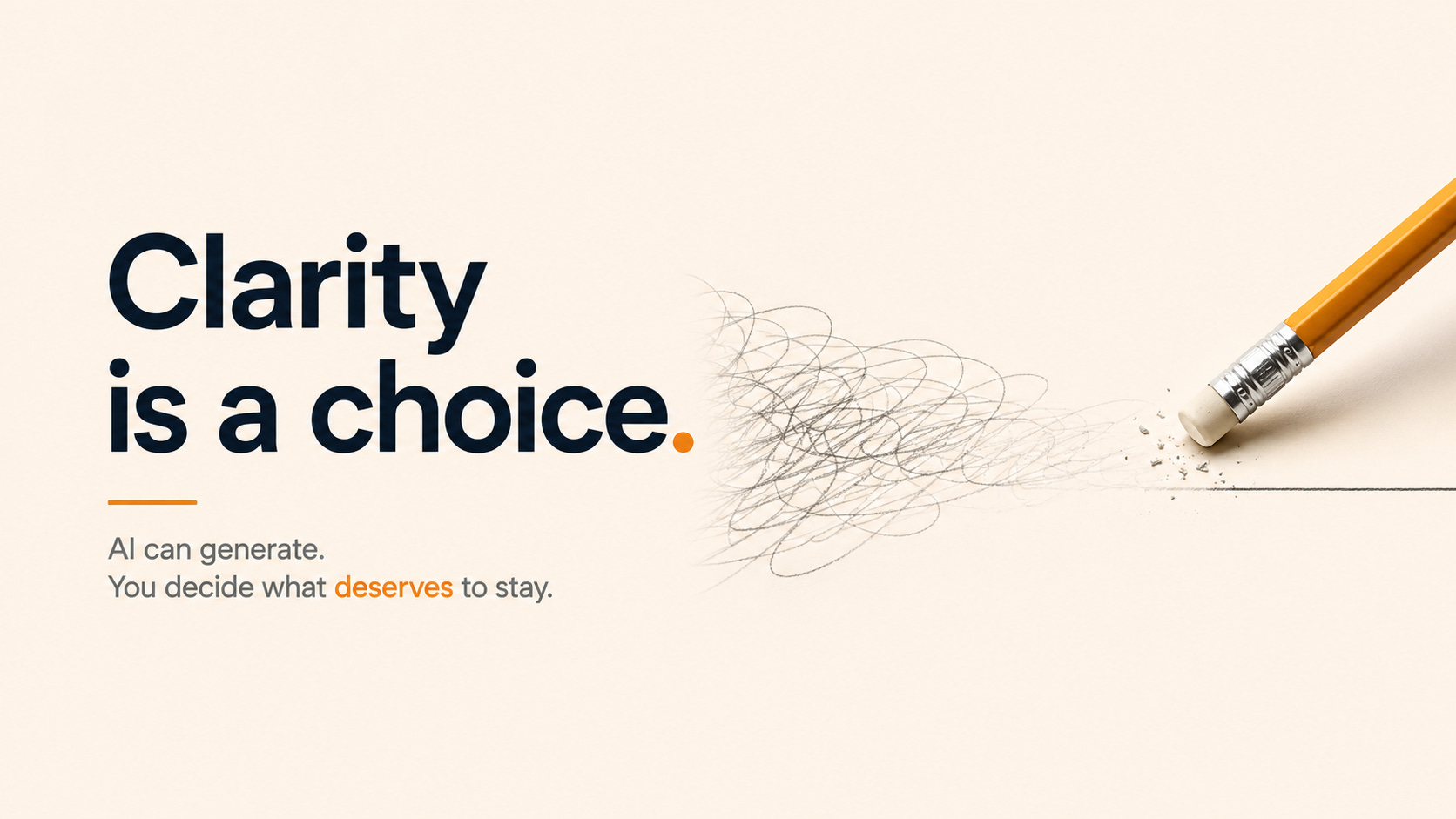
That is where AI becomes useful. Not as a machine for producing more words, but as a pressure test for whether the words deserve to stay.
The best AI users are ruthless editors
AI skill is not just prompting. It is judgment.
The competitive advantage will not belong to the person who can generate the most. Everyone can generate now. The advantage belongs to the person who knows what to keep, what to cut, and what the audience actually needs.
That is a different standard.
It is not “make this sound smarter.”
It is “make this more useful.”
The smartest person makes the room smarter
The goal is not to sound like the smartest person in the room.
The goal is to make the room smarter.
That means saying the thing that helps. Cutting the part that does not. Respecting the reader’s time. Using AI to clarify, not inflate. Thinking before speaking. Editing before sending. Choosing contribution over performance.
Communication is not judged by how much you say. It is judged by what your words help someone do next.
If your business is buried in long documents, bloated workflows, unclear messaging, or AI-generated noise, you do not need more output. You need sharper systems and clearer decisions. I help SMBs simplify how work gets communicated, automated, and executed so the team can stop wasting time and focus on what actually moves the business forward. If that is the problem you are staring at, reach out and let’s talk.
Reach out through [email protected] if your team spends more time communicating work than moving work forward.