Seventy-five percent of global knowledge workers now use generative AI at work, according to Microsoft and LinkedIn. That is no longer a niche technology wave. It is a labour market reset happening inside the workday, inside the inbox, inside the spreadsheet, and inside the parts of the job people used to think made them indispensable.
So if you automated 95% of your job and now work two or three hours a day, congratulations. You found efficiency. But do not confuse that with value.
The uncomfortable truth is simple: AI did not automatically make you more valuable. It may have revealed that most of your old task stack was repetitive, procedural, and easy to compress. The value question starts after the automation works. What do you do with the time?

The uncomfortable truth about automating your own job
Goldman Sachs Research estimates that generative AI could raise global GDP by 7%. That kind of economic impact does not come from everyone quietly doing less. It comes from workflow redesign, productivity expansion, new business models, and labour being pushed toward higher-value work.
That distinction matters. Automating tasks is not the same as creating value. If a tool removes most of your visible work and the business gets the same output with less effort, the business has learned something about the work. It has learned which parts were dependent on you, and which parts were dependent on a process that could be copied.
Microsoft’s 2024 Work Trend Index makes the tension obvious. 90% of AI users say it helps them save time, 85% say it helps them focus on their most important work, 84% say it helps them be more creative, and 83% say it helps them enjoy work more. Those numbers are strong, but they also create a standard. If AI saves you time, the next question is whether that time becomes better decisions, better systems, more revenue, cleaner execution, or sharper strategy.
If the answer is just hidden idle time, you did not move up the value chain. You made yourself quieter.
Efficiency is not the same thing as importance
Seventy-eight percent of AI users are bringing their own AI tools to work, and Microsoft found that the number rises to 80% at small and medium-sized companies. Employees are already automating around the official process. The tools are moving faster than policy, training, and leadership.
That creates a dangerous illusion. People feel more efficient, so they assume they are more important. But the market does not reward secret efficiency by itself. It rewards outcomes.
A smaller calendar does not automatically mean a bigger contribution
Microsoft found that 68% of people struggle with the pace and volume of work, while 46% feel burned out. AI can absolutely reduce that load. It can summarize meetings, draft documents, sort information, prepare analysis, and kill a lot of low-value motion.
Good. Kill it. Low-value work should not be protected just because it kept your calendar full.
But saving ten hours a week only matters if those ten hours get redirected into something that compounds. A better workflow. A clearer dashboard. A customer problem nobody has owned. A margin leak. A hiring bottleneck. A better sales process. A decision the business has been avoiding because everyone was too busy answering emails.
Time saved is raw material. It is not the finished product.

The market rewards outcomes, not hidden idle time
The same Microsoft report found that 52% of people who use AI at work are reluctant to admit they use it for important tasks, and 53% worry that using AI on important work makes them look replaceable. That fear is rational, but hiding the tool is the wrong response.
If your defence is, “I hope nobody notices the work takes one-tenth of the time now,” you are not building leverage. You are betting your role on opacity.
That is weak strategy. The stronger move is to make the productivity gain visible and attach it to a better business outcome. Do not say, “I automated my reporting.” Say, “I automated the reporting, cut the cycle time, found the variance sooner, and used the extra capacity to fix the decision process around it.” One sounds replaceable. The other sounds like ownership.
AI should move you up the value chain, not help you disappear from it
PwC’s 2025 AI Jobs Barometer found that industries more exposed to AI have 3x higher growth in revenue per employee. That is the real signal. AI is not just making people faster. In the right hands, it is making work more economically productive.
PwC also found that wages are rising 2x faster in the most AI-exposed industries, and workers with AI skills command a 56% wage premium compared with workers in the same job without AI skills. The market is not saying, “Automation makes everyone worthless.” It is saying, “People who can turn automation into measurable value are worth more.”
That is the standard. Use AI to eliminate low-value execution, then climb immediately.
Move from task completion to systems. Move from systems to judgement. Move from judgement to ownership. Move from ownership to measurable impact. That is the path. Anything else is just a more comfortable way to become optional.
For SMBs, this is especially important. Smaller teams do not have the luxury of random tool adoption. If automation gives back ten hours a week, that time should go into revenue, operations, customer experience, cash flow, hiring quality, or management capacity. If it does not, the business has installed software without changing performance.

The comfort gap is where careers get cut
Sixty-six percent of leaders say they would not hire someone without AI skills, according to Microsoft and LinkedIn. Seventy-one percent say they would rather hire a less experienced candidate with AI skills than a more experienced candidate without them. That is not a subtle labour market signal.
AI is changing what competence looks like. Experience still matters, but experience without adaptation is losing negotiating power.
Coasting after automation is the fastest way to make the business question your role
PwC found that skills for AI-exposed jobs are changing 66% faster than for other jobs. Last year, PwC measured the gap at 25%. The pace is accelerating, not stabilizing.
That means the comfort gap is getting smaller. You do not have years to sit on a hidden productivity advantage. The organisation will eventually catch up. The software will become standard. The process will be redesigned. The manager will ask why the old workload required so many people. The client will ask why the invoice still looks the same.
If the only thing you did with automation was make yourself less visible, you made the decision easier for someone else.
Hiding productivity gains is not leverage. It is risk.
Microsoft found that 79% of leaders agree their company needs to adopt AI to stay competitive, but 59% worry about quantifying productivity gains, and 60% worry their leadership lacks a plan and vision to implement AI. That gap is where a useful person becomes valuable.
Leaders do not need more people quietly using tools in the background. They need people who can translate AI productivity into operating decisions. Where does the time go? Which workflow should be rebuilt? Which role should change? Which metric should improve? Which customer problem can now be solved faster?
If you can answer those questions, you are not the person AI replaces. You are the person who helps the business stop wasting time.

Use AI to become harder to remove
Goldman Sachs Research estimates the total addressable market for generative AI software at $150 billion, compared with $685 billion for the global software industry. That is a massive signal that AI is being embedded into normal business systems, not sitting off to the side as a novelty.
Microsoft found that global skills are projected to change by 50% by 2030, and generative AI is expected to accelerate that shift to 68%. The implication is blunt: your current task list is not a moat. Your ability to adapt, redesign work, and create business outcomes is the moat.
So the operating standard is this:
-
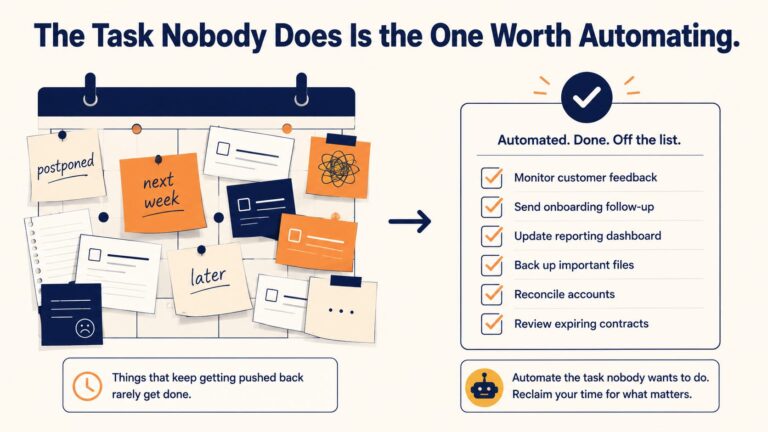
Automate the repetitive work. Do not romanticize busywork.
-
Make the productivity gain visible. Hidden efficiency is fragile.
-
Reinvest the time upward. Use it for systems, judgement, customer value, revenue, margin, or speed.
-
Attach automation to a business metric. If nothing improves, you are just doing less.
-
Build skills faster than your role changes. Waiting is not a strategy.
This is the real AI career strategy. Do not use automation to protect your old workload. Use it to prove you can operate above it.
The people who win this shift will not be the ones who secretly work three hours a day and hope nobody asks questions. The winners will be the ones who use AI to buy back time, then spend that time on work that actually matters.
If your business is adopting AI but the work still feels scattered, political, or unclear, that is the problem to solve. I help SMBs turn automation into practical leverage: cleaner workflows, better decisions, stronger systems, and less wasted effort. If you want to use AI without turning it into another shiny distraction, reach out. Let’s find the work that actually matters and build around that.