GitHub’s controlled Copilot study found developers completed a coding task 55% faster with AI assistance. That is the part everyone wants to talk about. Faster prototypes. Faster interfaces. Faster workflows. Faster shipping. The obvious takeaway is that AI has made building easier.
The less comfortable takeaway is that AI has also made wasting time easier. When the cost of adding another feature drops, weak product judgment gets more expensive. Not because the feature is hard to build, but because every unnecessary feature pulls you further away from the only thing that matters: the customer’s real problem.
That is the new founder trap. You start with a tight MVP. AI suggests three extra workflows. Then five more. Then a dashboard. Then onboarding logic. Then a second persona. Suddenly you have a polished product map, a beautiful interface, and no proof that anyone actually needs the thing.
Building a startup still requires the old, unsexy work: talking to people, hearing what hurts, testing whether they care, and learning whether they would pay. AI can help you move faster. It cannot replace customer validation.
AI Turned “Can We Build This?” Into the Wrong Question
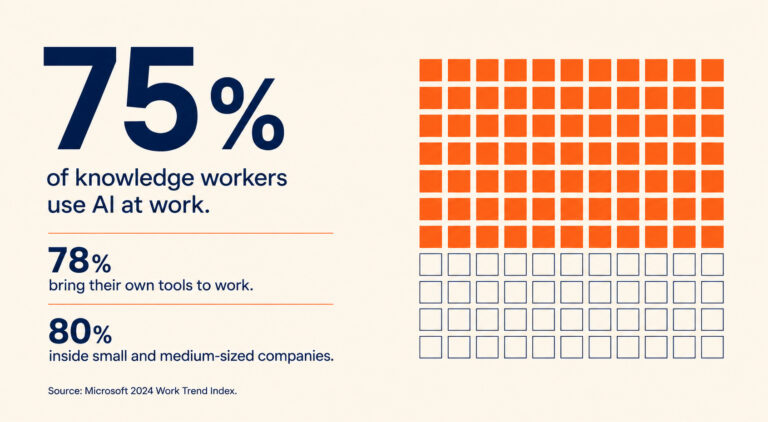
Microsoft and LinkedIn’s 2024 Work Trend Index found that 75% of global knowledge workers are already using AI at work, and users say AI helps them save time at a massive rate. 90% say it saves time, 85% say it helps them focus on important work, and 84% say it makes them more creative.
That is not a small shift. AI is not sitting on the edge of the workflow anymore. It is inside the workflow. It is helping people draft, code, research, design, analyse, summarize, and prototype. For founders and operators, that means the gap between idea and execution has collapsed.
But when execution gets easier, the question has to change. “Can we build this?” is no longer a serious filter. In most cases, yes, you can. You can probably build the feature, wire the automation, generate the page, mock the dashboard, and polish the copy faster than ever before.
The better question is: who asked for this?
If the answer is “AI suggested it,” “I thought it would be cool,” or “it would make the product feel more complete,” you are not building strategically. You are decorating. And decorating an unvalidated product is one of the cleanest ways to waste your time.
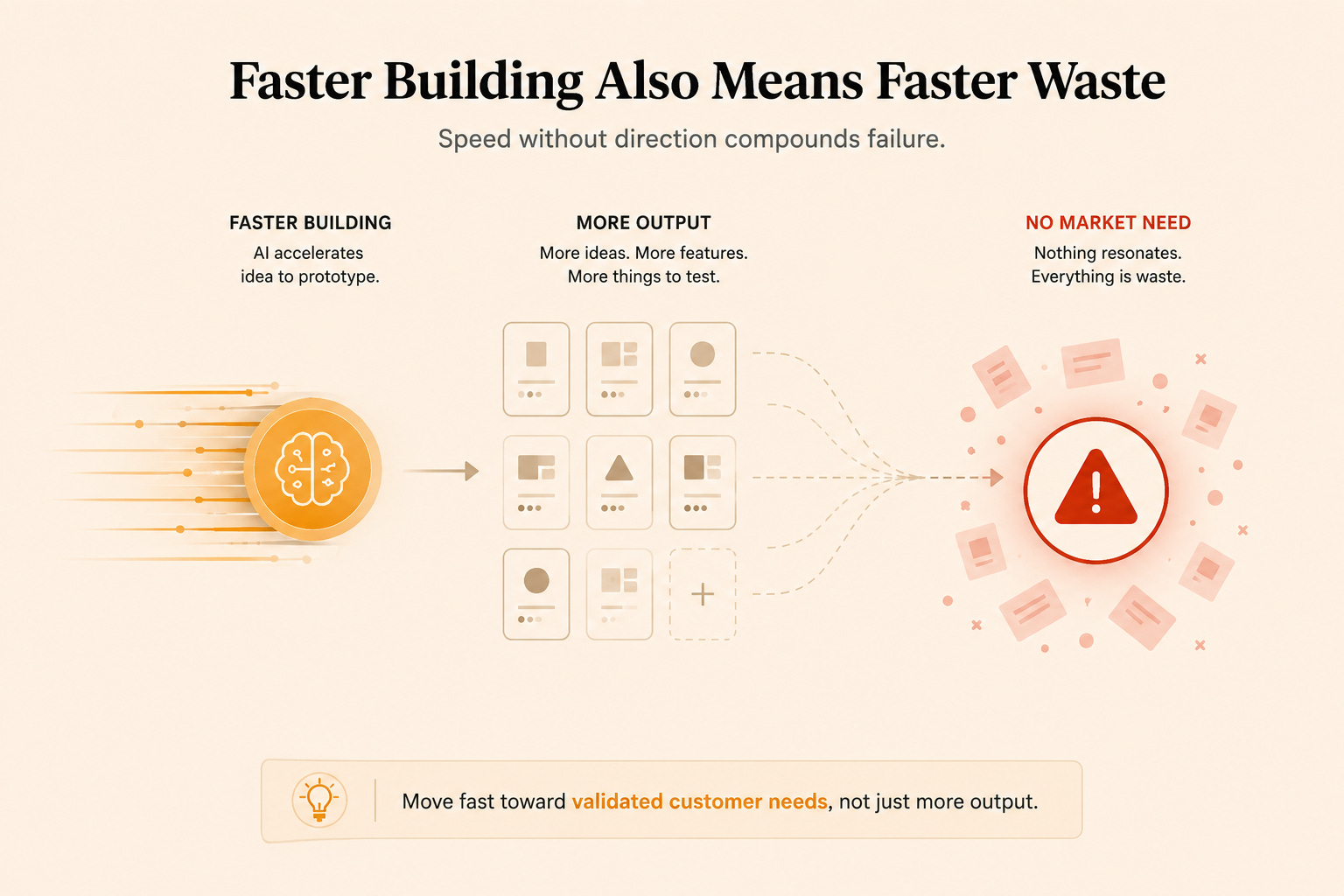
Faster Building Also Means Faster Waste
In the same GitHub research, developers using Copilot completed the test task at a higher rate, 78% versus 70%, and finished significantly faster. That is powerful. It also means a founder can now reach the wrong destination with more confidence, more polish, and less friction.
This is where AI scope creep gets dangerous. The extra feature does not feel expensive anymore. The prompt is cheap. The code is cheap. The mockup is cheap. The strategy debt is not.
The classic startup failure pattern has not disappeared. CB Insights’ startup postmortem analysis found that 42% of failed startups cited “no market need” as a reason for failure. Not “we could not build it.” Not “the interface was not polished enough.” The market did not need what they built.
That stat should bother every AI-era builder. Because AI attacks the easy part of the problem. It helps you make things. It does not magically prove that people want those things. Your customers still have to tell you what matters. They still have to show you what hurts. They still have to care enough to change behaviour, spend money, or make room in their workflow.
If you skip that part, you are not moving faster. You are just producing waste at a higher frame rate.
The Founder Trap Is Falling in Love With the Build Instead of the User
Stanford and MIT researchers studied the rollout of a generative AI assistant across 5,179 customer support agents. Productivity increased by 14% on average, with a 34% improvement for novice and lower-skilled workers. AI can absolutely accelerate execution, especially for people who are still climbing the learning curve.
But product-market fit is not an execution-speed contest. The founder who ships five features without customer insight is not ahead of the founder who ships one feature tied to a real pain. They are just busier.
This is where builders lose the plot. They start falling in love with the product instead of the person being served. The build becomes the source of momentum. The customer becomes a vague theory. The product gets cleaner, broader, and more impressive, while the original problem gets blurrier.
Y Combinator has repeated the same blunt advice for years because it keeps being true: founders need to talk to users. Not survey them from a distance. Not infer everything from analytics. Talk to them. Ask what they are doing now. Ask what is broken. Ask what they tried before. Ask what they would pay to fix.
Your customers are going to tell you what they need. AI is not going to fully do that. AI can summarize interviews, draft questions, cluster pain points, and help you see patterns. But it cannot manufacture demand. It cannot make a customer care.
MVP Discipline Matters More When Everything Feels Possible
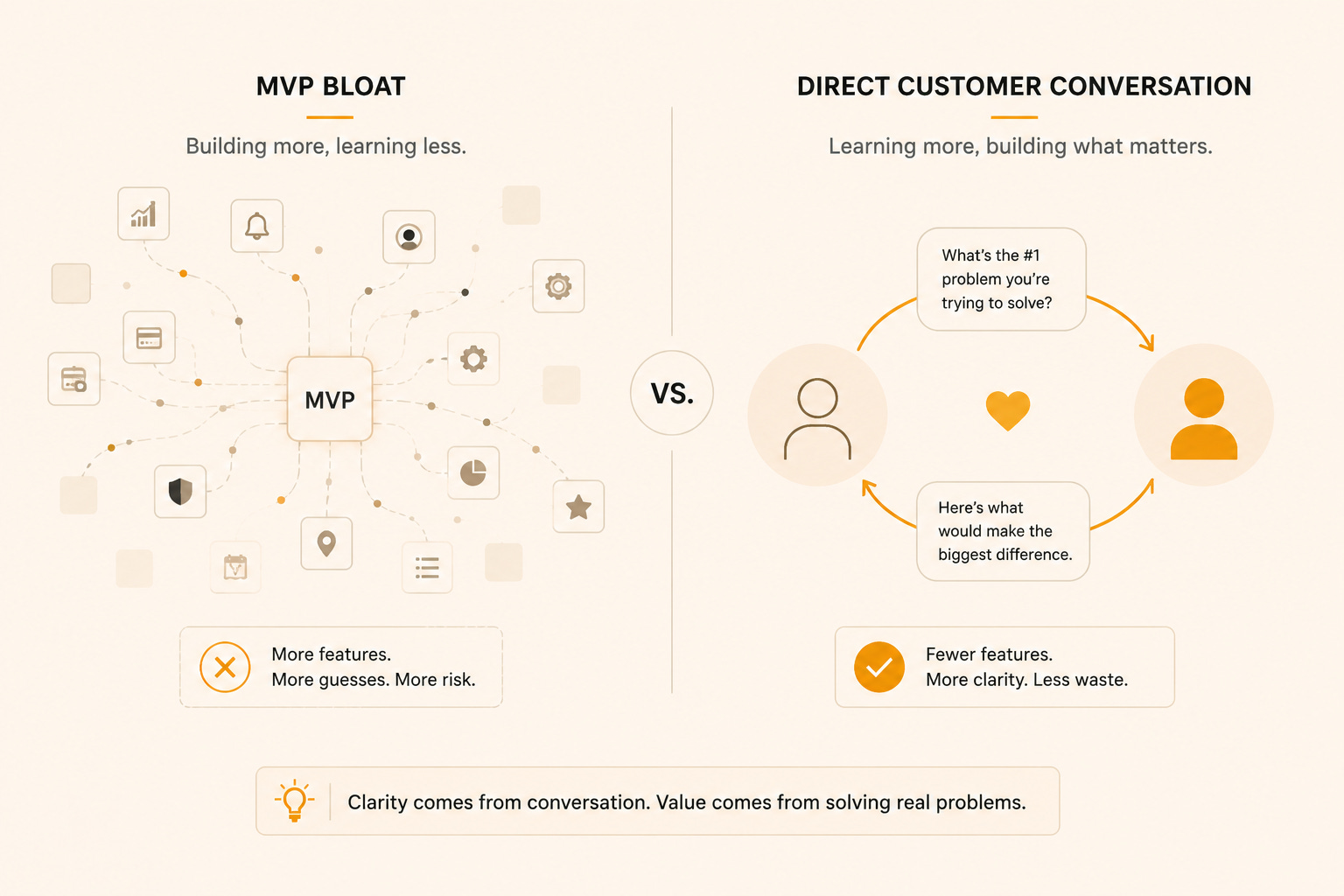
ProductPlan defines feature creep as the moment a team keeps adding features until they undermine the product’s value, making it complicated, confusing, or disconnected from the original product vision. That is exactly what AI makes easier.
An MVP is supposed to test the core problem. That is it. It is not supposed to prove that you can build every adjacent idea. It is not supposed to become a playground for every “what if” that shows up in a chat window.
The mutation usually looks innocent:
-
Version one: a focused tool that solves one urgent problem.
-
Version two: a few helpful additions because they were easy to generate.
-
Version three: multiple workflows for different users who have not been interviewed.
-
Version four: a bloated product nobody clearly asked for.
Pendo has reported that roughly 80% of software features are rarely or never used. Even if your exact product category performs better, the warning is obvious: most teams overestimate how much of their product users actually care about.
Feature bloat is not harmless. Every extra option adds cognitive load. Every extra workflow creates maintenance. Every extra promise complicates positioning. Every extra screen gives a customer another reason to hesitate.
Restraint is not weakness. Restraint is strategy. It protects the customer problem from your own excitement.
Before You Add the Feature, Talk to the Customer
Microsoft’s Work Trend Index also found that 60% of leaders worry their organization lacks a plan and vision to implement AI, while 59% worry about quantifying productivity gains. That is not just an enterprise problem. Small teams and founders have the same issue in a different form. They adopt speed before they define judgment.
The product filter has to move back to the customer. Before you add the feature, ask the uncomfortable questions:
-
Who specifically asked for this?
-
What pain does it solve?
-
How are they solving that pain today?
-
Would they use this weekly, or is it just nice to have?
-
Would they pay for it?
-
Does it strengthen the core promise, or dilute it?
-
What would we remove if we added this?
If you cannot answer those questions from real customer conversations, you do not have a product decision. You have a guess.
And guesses are fine at the beginning. Startups are built on guesses. But the whole point of customer validation is to stop worshipping your own assumptions. The customer conversation is where your idea gets pressure-tested against reality.
This is the part AI cannot save you from. It can make the artefact faster. It can make the presentation cleaner. It can help you sound sharper. But the customer still decides whether the thing matters.
Build Faster, But Earn the Right to Build More
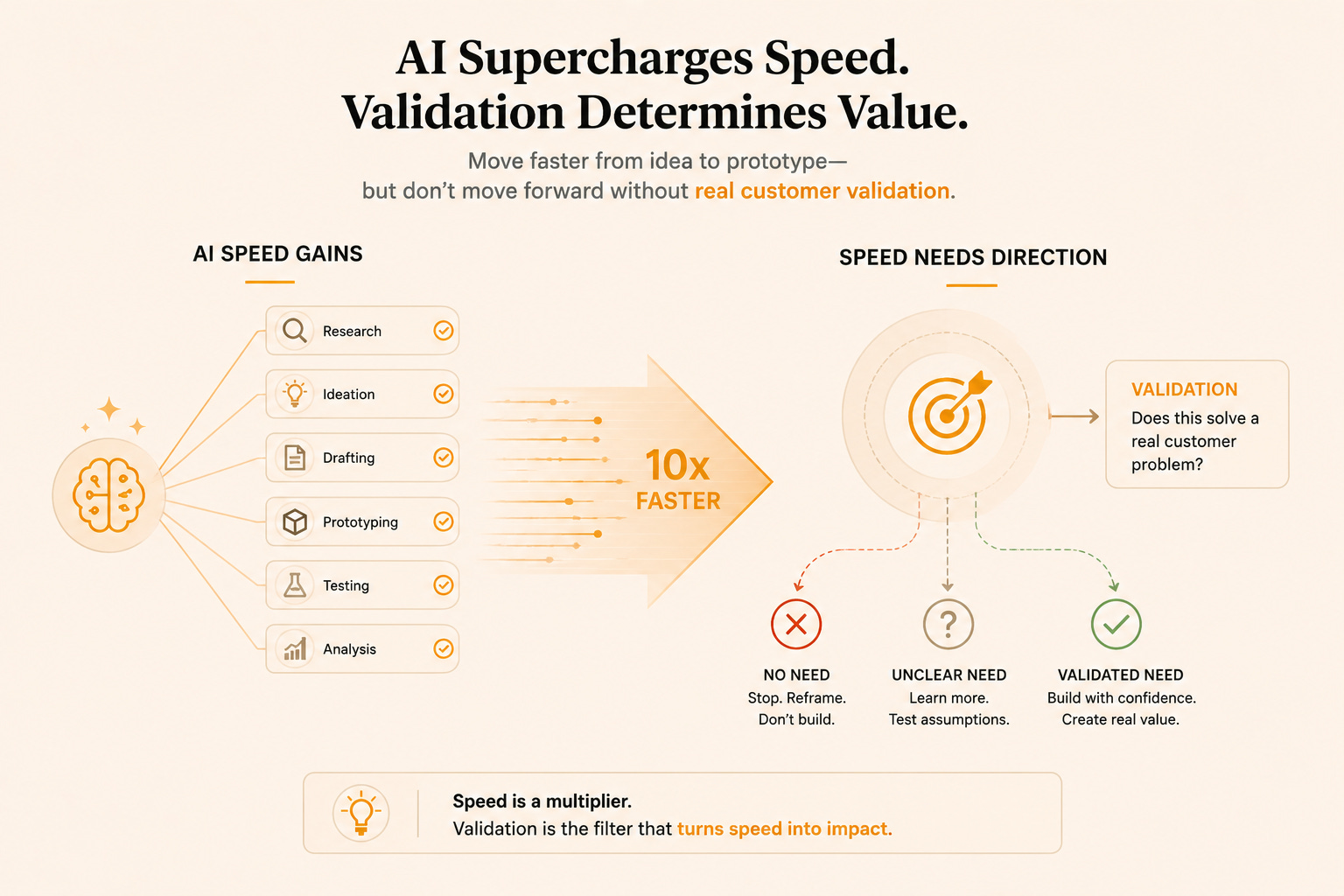
AI is a force multiplier. Used well, it helps you get to learning faster. Used poorly, it helps you avoid learning by staying busy with the build.
The difference is discipline. The best AI-era builders are not the ones who build everything. They are the ones who protect the customer problem, validate the pain, and resist the temptation to expand before the market gives them a reason.
That is the serious lesson here. Do not lose sight of the goal. The goal is not to produce more screens. It is not to impress yourself with velocity. It is not to turn every MVP into a full platform because the tools made it possible.
The goal is to solve something real for someone real.
So use AI. Move fast. Prototype aggressively. Cut the boring work. But before you add the next feature, get back in front of the customer. Talk to people. Ask what they need. Listen for pain, not compliments. Build the smallest thing that proves the problem is real, then earn the right to build more.
If you are building an AI-enabled product, workflow, or internal tool and you are not sure whether you are creating leverage or just adding complexity, I can help. At JC Labs, I work with SMBs and founders to identify where AI should create real business value, where automation makes sense, and where restraint is the smarter move. If you want to build faster without wasting time, let’s talk about what actually matters.