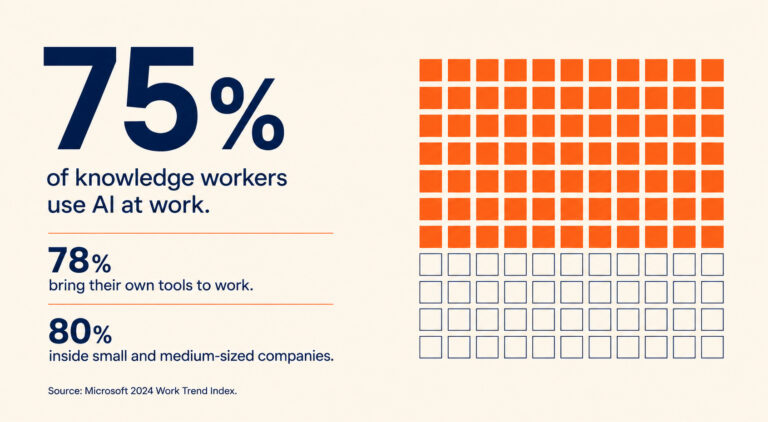
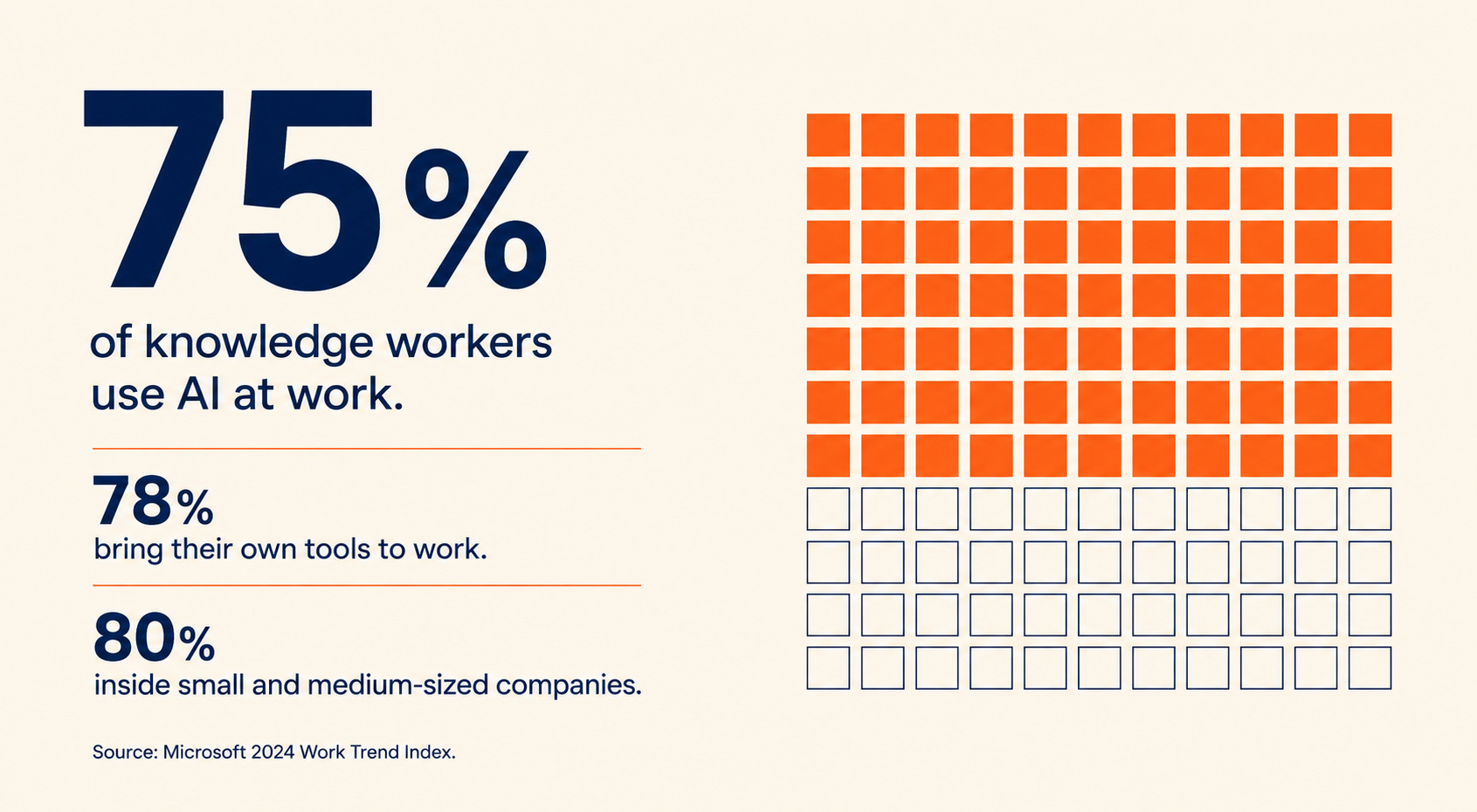
Seventy-five percent of knowledge workers now use AI at work, according to Microsoft’s 2024 Work Trend Index. That should sound like a breakthrough. It is not. It is a warning.
The same research found that 78% of AI users bring their own AI tools to work, and that number rises to 80% inside small and medium-sized companies. Translation: the AI adoption problem is not that your team refuses to use AI. The problem is that they are already using it without a system.
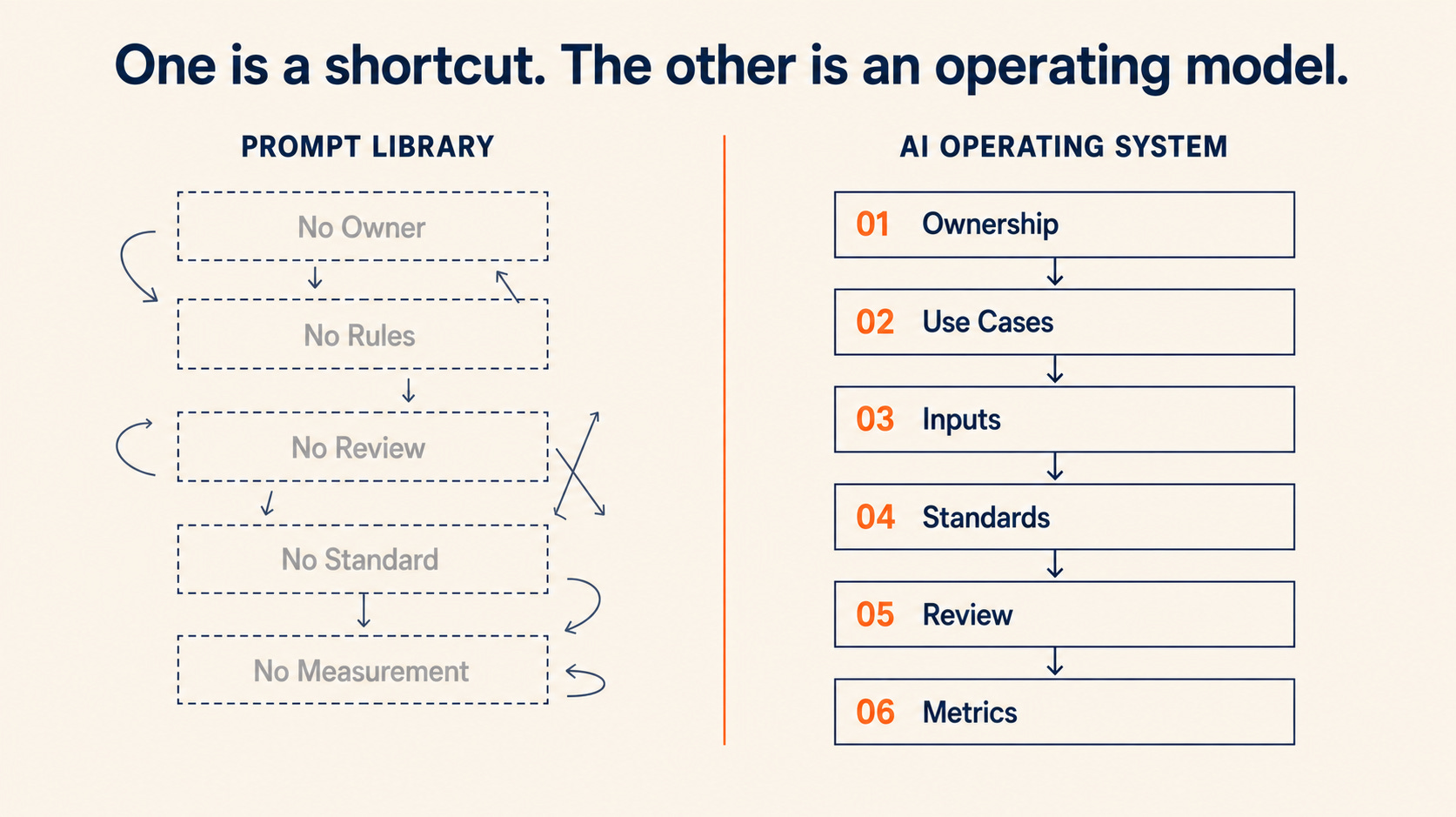
That is where most business owners are getting fooled. They see people swapping prompts, saving templates, testing tools, and sharing screenshots. It looks like progress. It feels like momentum. But prompt libraries are not strategy. They are scattered individual hacks. Useful in the moment, weak as an operating model.
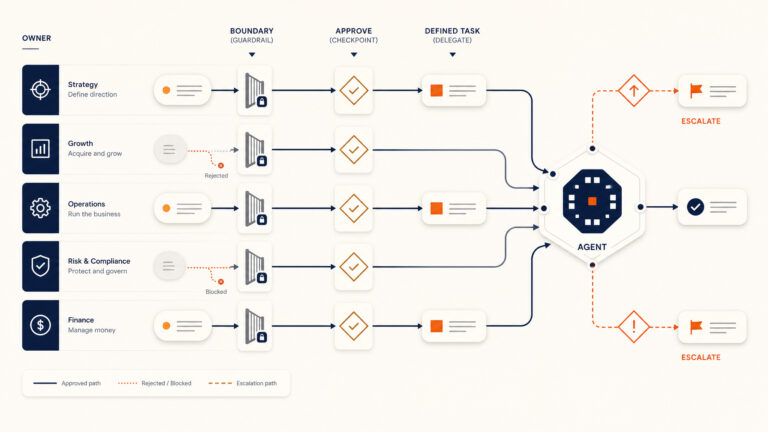
Your team does not need a bigger prompt folder. It needs an AI operating system for business: clear ownership, approved workflows, data rules, review standards, escalation paths, and a way to measure whether AI is actually improving the work.
If that sounds less exciting than another prompt pack, good. The exciting part is usually where companies waste time.
The Prompt Obsession Is AI Theatre
Microsoft found that 90% of AI users say AI helps them save time, 85% say it helps them focus on important work, and 84% say it helps them be more creative. Those are strong numbers. They also explain why prompt culture spread so fast.
Prompts give individuals a fast win. A salesperson drafts a better follow-up. An operator summarizes a messy thread. A manager turns notes into a cleaner memo. That matters. But individual productivity is not the same thing as team-level leverage.
The gap shows up immediately. One employee gets a great output because they know the right context. Another gets nonsense because they copy the prompt without understanding the task. One person pastes customer data into an unapproved tool. Another uses AI to draft a client response but nobody reviews it before it goes out. Everyone is “using AI,” but the business has no shared standard.
That is not transformation. That is AI sprawl.
The prompt obsession is attractive because it lets leaders avoid the harder work. It feels easier to ask, “What prompts should my team use?” than to ask, “Which workflows should AI touch, who owns them, what data can be used, and how do we know this made the business better?”
That harder question is the only one worth asking.
Why Prompt Libraries Fail Inside Real Teams
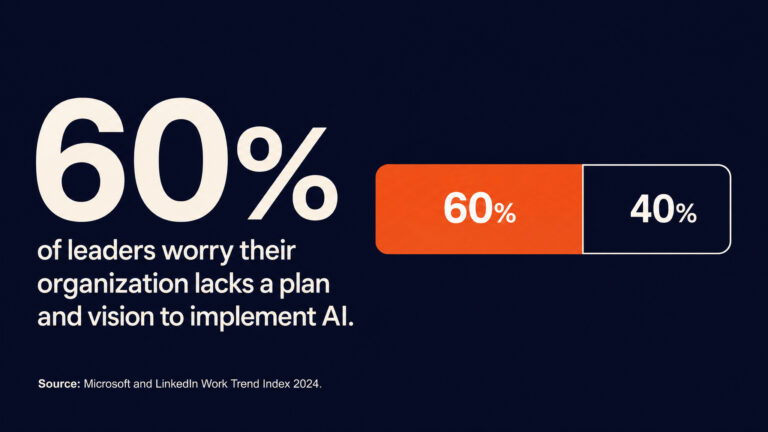
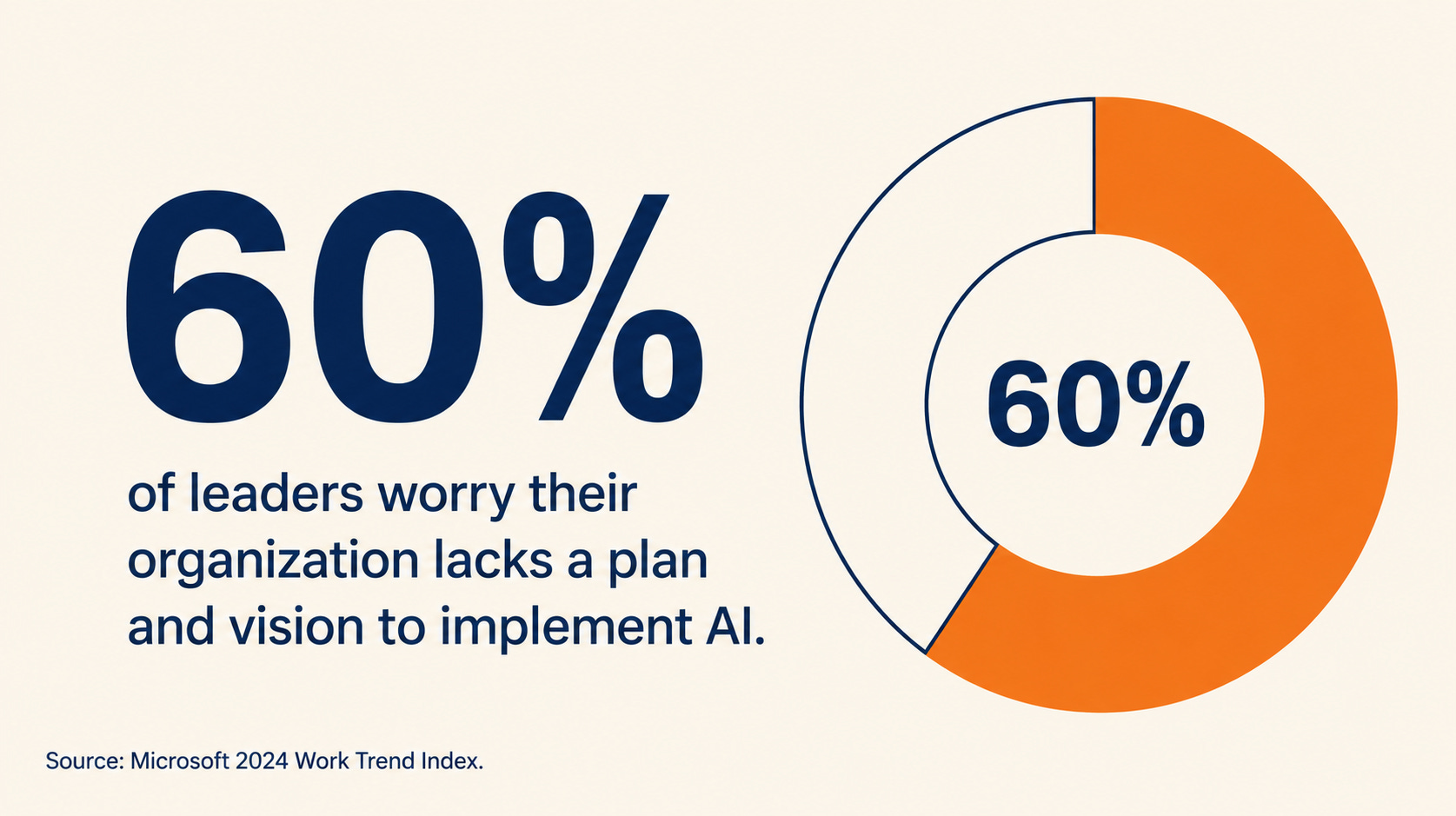
Microsoft also found that 60% of leaders worry their organization lacks a plan and vision to implement AI. That number should bother every SMB owner because the employees are not waiting for the plan. They are already improvising.
A prompt library fails because it treats AI like a writing shortcut instead of a management system. It assumes the hard part is wording the request. It is not. The hard part is knowing what work should happen, what information is trusted, what decision the output supports, and who is accountable after AI produces something.
Prompts do not answer those questions.
A prompt can help draft a customer email. It cannot decide whether that email should be sent without review. A prompt can summarize a sales call. It cannot define which fields belong in the CRM or who follows up when budget is unclear. A prompt can produce a project plan. It cannot decide which team has capacity, which risks matter, or what should be escalated.
That is why prompt libraries usually decay. People stop using them, modify them quietly, or keep private versions that work better for their own role. The business ends up with ten slightly different ways to do the same work and no visibility into which one is right.
For an SMB, that is expensive. Not because prompts are bad, but because unmanaged variation kills consistency.
What an AI Operating System Actually Means
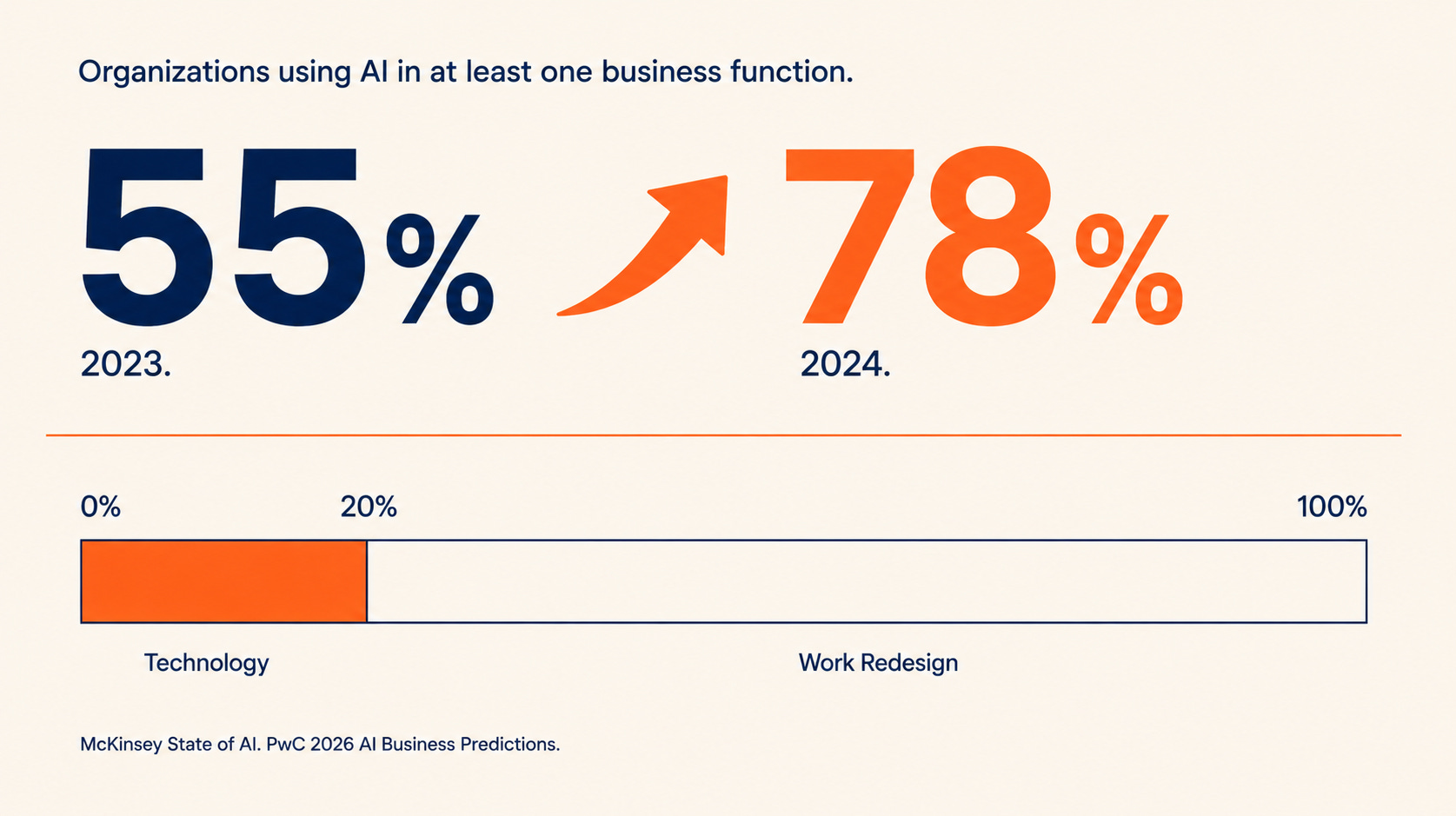
McKinsey’s State of AI research found that 78% of organizations report using AI in at least one business function, up from 55% in 2023. Adoption is broad. Scale is still the problem. Many companies are using AI somewhere, but far fewer have turned it into a repeatable operating model.
That is the difference between using AI and operating with AI.
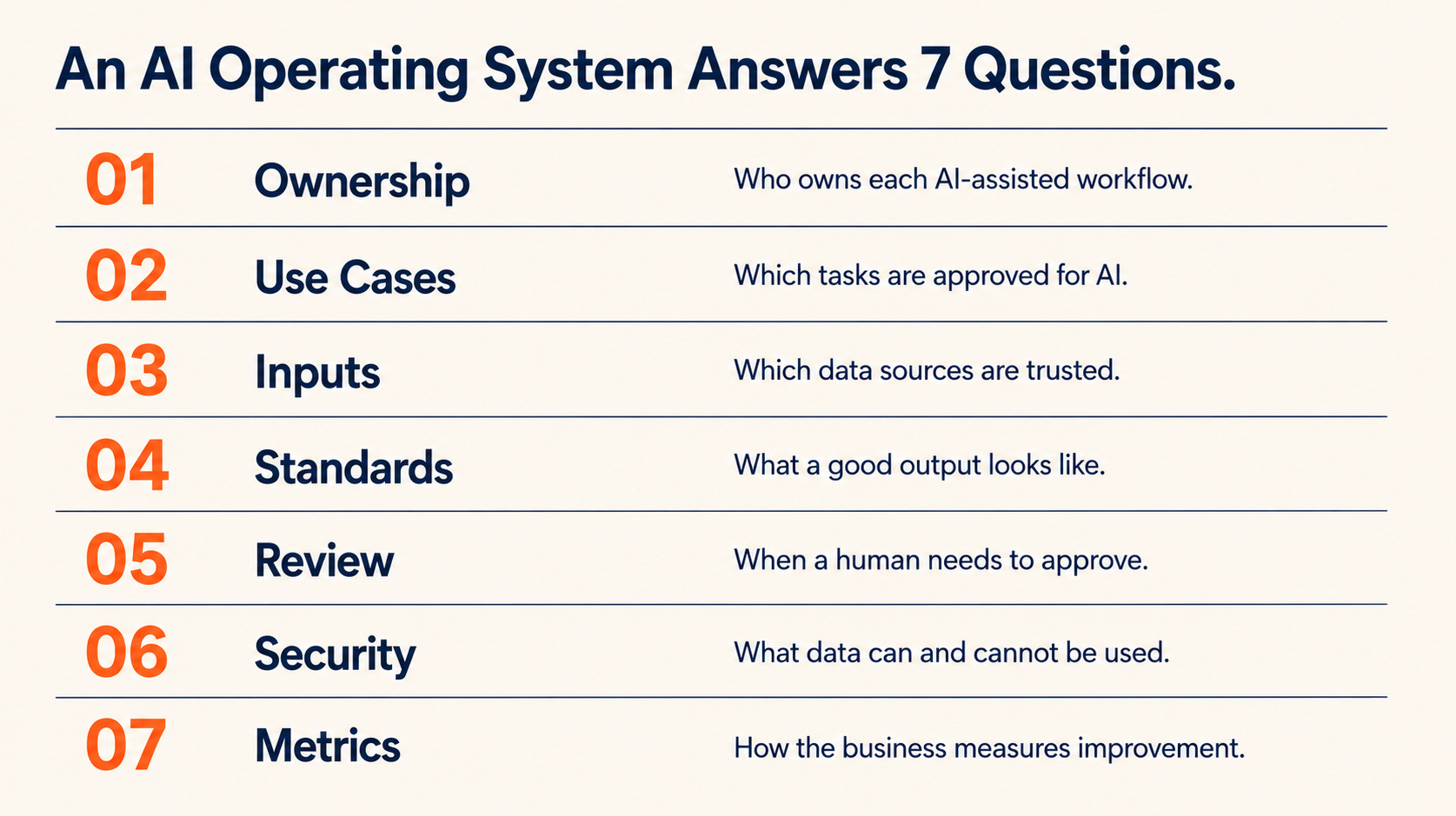
An AI operating system is not one tool. It is the set of decisions that makes tools useful across a team. For an SMB, it should answer seven questions:
-
Ownership: who owns each AI-assisted workflow?
-
Use cases: which tasks are approved for AI, and which are off-limits?
-
Inputs: which documents, data sources, and examples are trusted?
-
Standards: what does a good output look like?
-
Review: when does a human need to check, edit, or approve?
-
Security: what data can and cannot be pasted into tools?
-
Metrics: how will the business measure time saved, error reduction, speed, quality, or revenue impact?
That is the operating system. Prompts sit inside it. They do not replace it.
Think about customer service. A prompt library might give the team a template for replying to angry customers. An AI operating system defines which complaints AI may summarize, which refund scenarios need manager approval, which source of truth the response must use, what tone is acceptable, and how escalations are tracked.
One is a text shortcut. The other is a controlled workflow.
The Real Bottleneck Is Management, Not Model Capability
PwC’s 2026 AI Business Predictions makes the management issue blunt: technology delivers only about 20% of an initiative’s value. The other 80% comes from redesigning work.
That is the part most companies skip. They want the AI gain without the workflow redesign. They want faster work without clarifying ownership. They want automation without deciding what should happen when the tool is wrong.
That is how you get busy AI and weak results.
The model is rarely the first bottleneck inside an SMB. The bottleneck is usually undocumented process, unclear handoffs, messy inputs, inconsistent review, and nobody measuring whether the change mattered. AI does not fix that by magic. It exposes it.
If your sales process is unclear, AI will generate faster unclear follow-ups. If your onboarding process is inconsistent, AI will produce faster inconsistency. If your reporting process has no owner, AI will create prettier reports that still do not change decisions.
This is why the phrase “AI operating system” matters. The system forces the business to define how work should move before it tries to accelerate the movement.
How SMBs Can Start Without Overbuilding
Do not turn this into a 90-page governance binder. That is just another way to waste time. SMBs need something lighter, sharper, and actually used.
Start with one workflow that happens every week and causes real drag. Good candidates are inbound lead handling, quote preparation, customer support triage, meeting follow-up, product content updates, internal reporting, or recurring admin work.
Then build a simple operating layer around that workflow:
-
Define the job: one sentence describing what AI helps with.
-
Name the owner: one person accountable for the workflow.
-
Set the input rules: what information AI can use.
-
Create the standard: what a good output must include.
-
Add the review rule: what must be checked before use.
-
Track one metric: time saved, faster response, fewer misses, better conversion, or fewer revisions.
That is enough to begin. You can add more structure after the first workflow proves value. The point is not to become bureaucratic. The point is to stop pretending that prompt sharing is the same thing as business design.
This is where smart hustle beats stupid hustle. A team collecting random prompts is busy. A team redesigning one workflow with ownership, rules, and measurement is building leverage.
Stop Collecting Prompts. Start Operating Better.
The companies that win with AI will not be the ones with the largest prompt library. They will be the ones that turn AI from individual improvisation into repeatable operating advantage.
That means fewer random experiments and more deliberate systems. Fewer “try this prompt” messages and more approved workflows. Fewer vague productivity claims and more measured outcomes. Less theatre. More operating discipline.
If your team is already using AI but the results feel scattered, the answer is not another prompt pack. The answer is to decide where AI belongs in the business, how it should be used, who owns the output, and what result you expect from it.
That is the difference between playing with AI and building with it.
If you run an SMB and want AI to create actual leverage, I can help you map the workflows, define the operating rules, and build automations that fit how your business really works. Do not waste your time collecting prompts that nobody will use properly. Build the system that makes AI useful.